
ChatGPT for Sales: What OpenAI's Plugin Means for Sellers
OpenAI launched ChatGPT for Sales on November 17, 2026: a Sales plugin plus 30+ partner plugins. What it reads, what it writes in a CRM and what a seat costs.
On November 17, OpenAI launched ChatGPT for Sales: a Sales plugin and over 30 partner plugins. Clay, HubSpot and Pipedrive pages show what they touch in a CRM.
A US sales team of two to ten people has practical questions: which plan turns it on, which records can change, which training terms apply and what it costs.
OpenAI launches ChatGPT for Sales with 30+ partner plugins
OpenAI published "Introducing ChatGPT for Sales" on Tuesday, November 17, 2026, dated 08:00 GMT in its news feed. It pairs an OpenAI-built plugin with plugins from sales software vendors.
What the Sales plugin does
OpenAI calls the launch "a new Sales experience" and says it includes "our new Sales plugin with dedicated skills for sellers." Its feed lists the jobs: "research prospects, prepare pitches, update your CRM, and move deals forward." On the announcement page, OpenAI says the Sales plugin "gives you ready-to-use workflows for everyday sales work, from deciding which accounts to pursue to preparing for a call and drafting the follow-up."
After a call, OpenAI says ChatGPT can "prepare updates to the customer record," and the seller can "review the proposed changes" before saving them. In Friday's view, that write step matters more to a small team than the drafting, because it touches the system of record. OpenAI also describes "your dot—an always-on agent in ChatGPT," and with Rox, a dot that checks a deal each morning and prepares a brief "for your review."
Who is in the launch list
OpenAI groups the ChatGPT for Sales partners by job. For account context it names Salesforce, HubSpot, Close CRM and monday CRM. For prospect signals it names Apollo, Clay and Common Room, with Outreach or Salesloft to plan outreach. Call notes come from Gong, Otter.ai or Granola, and quotes and agreements from Docusign, PandaDoc, Ironclad or ServiceNow CPQ. ZoomInfo, Attio, Rox, Backstory and Hex appear in its examples too.
Clay, a prospecting and data enrichment platform, said on November 17 that it is "relaunching our MCP as part of OpenAI’s official sales launch." MCP, the Model Context Protocol, is the standard Clay's plugin uses to connect ChatGPT to Clay's tools. Pipedrive, which is not in OpenAI's launch list, announced its own ChatGPT app in December 2025.
Business and Enterprise admins switch on ChatGPT for Sales
OpenAI's setup note is written for workspace admins on Business and Enterprise. It leaves the individual plans unnamed, and each partner adds its own account rules on top of OpenAI's.
What the announcement and pricing page say
OpenAI says ChatGPT Business and Enterprise admins enable ChatGPT for Sales "by opening the Admin Console, selecting your workspace, and selecting Plugins," then make the Sales plugin and partner plugins available to install, or install them by default. It adds that "availability of partner plugins and features varies by plan, region, and workspace settings." The announcement does not name Plus or Pro, so whether a solo seller on those plans gets the Sales plugin is not stated.
The pricing page lists "Discover & use Plugins" on Free, Go, Plus and Pro, and sharing plugins with a workspace on Pro only. The Business page says Business "gives teams a secure workspace with shared company context, plugins, flexible seats, and admin controls."
Approval on the ChatGPT Business side
OpenAI's note tells admins: "Review access to the required apps and the actions they can use." Clay says that "on ChatGPT Business, admins choose whether Clay is enabled for the organization." HubSpot adds: "A ChatGPT workspace admin may also need to enable the updated HubSpot connector on their end." In Friday's view, that single admin switch on ChatGPT Business is the right place for a five-person team to decide which plugins may write to its CRM.
Accounts on the partner side
Each partner plugin also needs an account with that vendor. Clay says its MCP "works on every Clay plan, including free and trial," and that users need "Editor or Admin access in your Clay workspace." HubSpot says its connector "is available to all HubSpot customers across all plans with an OpenAI account," though some actions "may require an eligible HubSpot subscription." Pipedrive said in December 2025 that its app "requires an OpenAI Business, Enterprise, Edu or Pro plan to enable it."
Read access, write access and CRM data
Partner pages spell out what each plugin may touch. HubSpot's reads and writes records, Clay's builds audiences and campaigns, and Pipedrive's keeps a synced copy of CRM data for analysis.
HubSpot: chat, deep research and write actions
HubSpot says its connector supports "core CRM objects (contacts, companies, deals, tickets), campaigns, landing pages, leads, custom objects, and activatable objects," with "write actions to create and update records directly in HubSpot." Its own examples include listing deals closing this month and updating the lead status for contacts from a webinar. Deep research mode reads across CRM data "with citations back to originals."
The limit is the user's own access. HubSpot says the connector "mirrors your existing HubSpot permissions," so a rep sees in ChatGPT only the CRM data that rep can see in HubSpot, and "Super admins control which permissions are enabled and can revoke access at any time."
Clay: audiences, workflows and campaigns
Clay says the updated MCP "lets you build custom audiences, edit workflows, launch Sequencer campaigns and more, without leaving the chat," and that users can "pull data from your own CRM or use our data to find ideal fit customers." With its interactive previews, Clay says, "ChatGPT shows a search before it runs, refines the filters with you, and displays results, workflows and campaigns right in the chat." Friday's recommendation is to have one person read the audience, the CRM data it draws on and the campaign in that preview before anything launches.
Pipedrive keeps a synced copy
Pipedrive's December 2025 app works differently: once an admin sets it up, users link accounts, "allowing ChatGPT to regularly sync their accessible data." Pipedrive said the release "honors user access permissions, allows for easy disconnection and aligns with OpenAI’s data retention policies," and, as of December 2025, that it is "currently available for ChatGPT users outside EU data residency." In Friday's view, a synced copy of CRM data is a second place customer records live, and it belongs in the team's data inventory.
What ChatGPT for Sales costs a five-person team
OpenAI's announcement page shows no price for ChatGPT for Sales or the Sales plugin. The cost is the ChatGPT seat, the partner subscriptions underneath and the plan's data terms.
Training terms by plan
The pricing page lists "Content is used to train our models" with "Opt-out available" for Free, Go, Plus and Pro. The Business page says: "Your data is never used for training our models." HubSpot says ChatGPT "is a third-party service governed by your terms with OpenAI," so a partner plugin call moves data between OpenAI and the partner under both vendors' terms. Friday's recommendation for running ChatGPT for Sales on client records is a Business workspace, so the no-training term covers every seat.
Seats plus partner credits
OpenAI's help center, checked November 17, lists the ChatGPT Business standard seat at $25 per user per month billed monthly, or $20 billed annually, and the Premium seat at $125 monthly or $100 annually. The pricing page says "Business plans are available starting at 2 users." Five reps on annual ChatGPT Business standard seats cost $100 a month, or $1,200 a year. On Premium seats the same five cost $500 a month billed annually, or $625 billed monthly.
The partner bills sit on top. Clay says its MCP "uses the same credits and actions as working in the Clay app," and HubSpot says: "All functionality in ChatGPT is subject to HubSpot's API usage limits and guidelines." In Friday's view, the honest monthly figure for ChatGPT for Sales is the seats plus every partner subscription and credit pack the plugins call, written down before rollout.
Salesforce and HubSpot already sell AI inside the CRM
The plugins arrive next to AI the CRM vendors price into their own editions. Here is the ladder Salesforce publishes, what HubSpot bundles, and where a narrow workflow fits instead.
Salesforce's price ladder
Salesforce lists Starter Suite at $25 per user per month, Pro Suite at $100, Core at $195, Advanced at $395 and Max at $550, all billed annually except Starter, which can be billed monthly. It describes Core as "The CRM for sales with built-in AI, Slack, Tableau, and Agentforce skills," says Max includes "Agentforce for Sales and Agentforce Coworker," and adds that "AI can be added to Core and above."
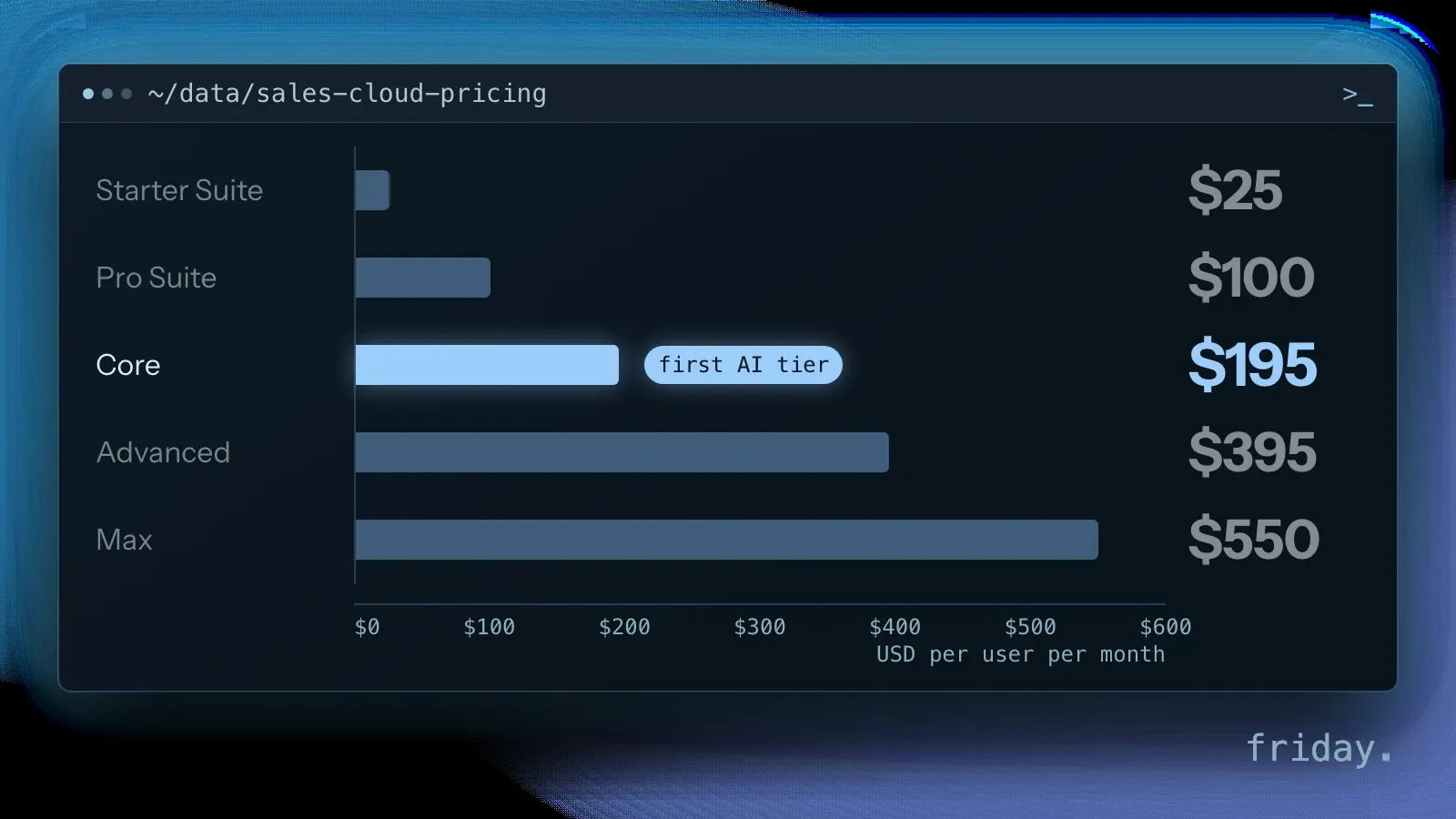
Picture a five-rep team on Starter Suite: AI from Salesforce starts at the Core seat. CRM-native AI runs on CRM data inside the vendor's own product and pricing, while ChatGPT for Sales reaches several tools at once and adds OpenAI as a second vendor on each request.
HubSpot's Agent Hub and credits
HubSpot says "Agent Hub is included in all Starter, Professional, and Enterprise editions" and that "Many AI features and agents run on HubSpot Credits." Its prospecting agent "watches accounts for signals that they're ready to buy and reaches out automatically." A HubSpot customer can compare that credit spend with ChatGPT for Sales seats for the same prospecting job.
Friday's view: a workflow for the step that repeats
In Friday's view, seats suit people who chat, and a workflow suits work that repeats. For example, a six-person insurance agency that only needs every new web lead enriched, scored and logged in its CRM does not need each producer in a chat window to do it. A small workflow that connects the tools you already pay for can run that step on every lead, log what it changed, and stay in accounts the business owns.
Friday's recommendation: start with one plugin and one job, give it read access first, and allow write actions after a week of checking what it would have changed. If the need is one repeatable step, such as logging call notes, price that step as a workflow before buying a seat for every rep. In Friday's view, a workflow built in the business's own accounts keeps its prompts, field mappings and logs if a vendor changes plans.
Before you turn on ChatGPT for Sales
The Sales plugin brings prospect research, call follow-up and CRM updates into ChatGPT. Three checks come first: which plan the team is on, what each plugin may write and what the full bill is.
Before rolling out ChatGPT for Sales, confirm the admin settings and each partner's write permissions, and add up seats plus partner credits. If you want to compare a plugin rollout with a small workflow on your own lead data, tell us which CRM and tools your sales team uses.
Last checked: November 18, 2026, against OpenAI's announcement and news feed, ChatGPT pricing and Business pages, OpenAI's launch video, Clay's launch post, HubSpot's connector and AI pages, Pipedrive's newsroom and Salesforce's pricing page; ChatGPT Business seat prices against OpenAI's help center on November 17, 2026.
Plan, data and pricing details come from the vendors' own pages, checked November 18, 2026. Friday has no relationship with OpenAI, Clay, HubSpot, Pipedrive or Salesforce. Statements marked as Friday's view or Friday's recommendation are opinion.