
LiteLLM Vulnerability on CISA's Exploited List: What to Ask
On November 18, 2026, CISA listed a LiteLLM vulnerability as exploited. LiteLLM is a self-hosted gateway that holds the keys AI agents use to call their models.
If an agency or contractor built AI agents for your business, a LiteLLM proxy may sit between those agents and their models, with the model API keys inside.
Owners who only use ChatGPT, Claude or Gemini in a browser do not run LiteLLM. If someone else built or hosts your automations, ask them what runs there today.
November 18: CISA lists a LiteLLM vulnerability as exploited
The Cybersecurity and Infrastructure Security Agency added four flaws to its catalog on November 18. One is a LiteLLM vulnerability published in April, with a patched release out the same month.
What the CISA alert says
CISA's alert, released November 18, 2026, says the agency "has added four new vulnerabilities to its Known Exploited Vulnerabilities (KEV) Catalog, based on evidence of active exploitation." One of the four is CVE-2026-40217, which CISA calls the "BerriAI LiteLLM Unprotected Alternate Channel Vulnerability." BerriAI is the company that maintains LiteLLM. The other three entries concern Synology DiskStation Manager, Apache Axis and REDCap, a research data tool.
For this flaw, the alert gives no victims, no attackers and no description of how the flaw was used. CISA's catalog entry lists ransomware use as "Unknown." The alert also says that a flaw only enters the catalog with a CVE ID, "evidence of exploitation, and clear mitigation guidance." So the listing tells you CISA has evidence this LiteLLM vulnerability has been exploited. It does not say by whom or against whom, and nothing in it says small businesses were the targets.
An old flaw with a new status
CVE-2026-40217 is not new. NVD's record shows it was published on April 10, 2026. BerriAI's patched release, v1.83.10-stable, went out on April 27, and its security advisory followed on May 7 (UTC). What changed on November 18 is the status: a federal agency now says it has evidence the LiteLLM vulnerability is being exploited.
What the flaw does inside a LiteLLM proxy
LiteLLM is a self-hosted server that sits in front of AI models. The flaw lets someone with access to one guardrails test endpoint run their own code on that server, which holds the model keys.
What a LiteLLM proxy does for your agents
LiteLLM's documentation describes its gateway as "a self-hosted server" that gives applications "one OpenAI-compatible endpoint for 100+ LLM providers, MCP tools, and A2A agents." Your agents send requests to the LiteLLM proxy, and it forwards each one to the model provider. It also issues virtual keys with their own budgets, records the cost of each request and applies guardrails such as content filters and PII masking. To do that, the LiteLLM proxy holds the provider API keys: its documentation says the config can "save model-specific information like api_base, api_key." Its documentation calls the master key "your Proxy Admin key," and that key can create other keys.
A sandbox that could be escaped
The guardrails feature includes a test endpoint for custom code. BerriAI's advisory says "the POST /guardrails/test_custom_code endpoint runs user-supplied Python inside a hand-rolled sandbox," and that the sandbox "can be escaped using bytecode-level techniques, allowing arbitrary code execution in the proxy process — which runs as root in the default Docker image." In plain terms, this LiteLLM vulnerability means code that was supposed to stay in a box can run its own code inside the LiteLLM proxy process, which the advisory says runs as root in the default Docker image.
Who can reach the endpoint
The two records disagree on this point. BerriAI's advisory says: "Reaching the endpoint requires a proxy-admin credential in default configurations." The score that MITRE, the CVE numbering authority, filed and NVD displays uses a vector with low privileges required. Neither record says an anonymous visitor on the internet can exploit this LiteLLM vulnerability without logging in. Both say a credential is involved. They differ on how powerful it must be, and a non-default setup may change the answer.
Two severity ratings
MITRE's score, shown on NVD with the same score from Red Hat, is 8.8 out of 10, High. For this flaw, NVD's own entry reads "NVD assessment not yet provided." BerriAI rates the issue Moderate, with a CVSS version 4 score of 5.9. NVD's record also carries Red Hat's assessment, which lists Red Hat Lightspeed Core as affected, so LiteLLM can also arrive inside another vendor's product.
Four LiteLLM entries in the Known Exploited Vulnerabilities catalog
The November listing is the fourth time in 2026 that CISA has added a LiteLLM flaw to the Known Exploited Vulnerabilities catalog. Each entry asked federal agencies to fix it within two weeks or less.
May to November in the catalog
The feed of the Known Exploited Vulnerabilities catalog shows four LiteLLM entries added this year. On May 8, a SQL injection flaw that could lead to "unauthorized access to the proxy and the credentials it manages." On June 8, a command injection flaw that "any authenticated user, including holders of low-privilege internal-user keys," could use. On September 2, an authentication flaw in the MCP endpoint, the part that connects agents to tools. On November 18, CVE-2026-40217.
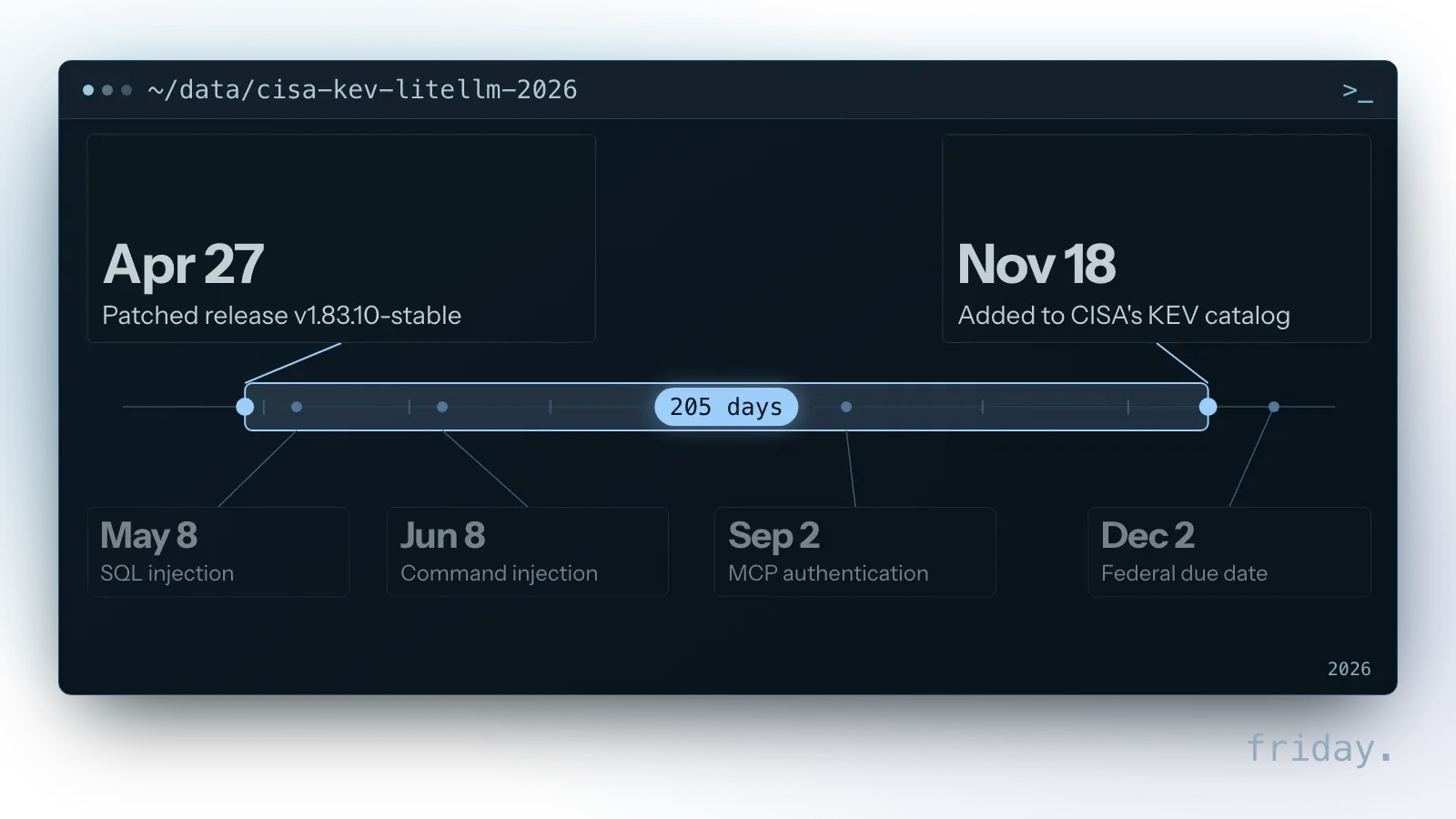
In Friday's view, the pattern across the Known Exploited Vulnerabilities catalog matters more to an owner than any single entry. A gateway with four exploited flaws listed since May needs someone watching it every month. A LiteLLM proxy installed in spring and never updated would have missed the later fixes.
What the Dec 2 date means for a private business
The catalog sets a due date of December 2, 2026, for this entry. That date binds federal civilian agencies under Binding Operational Directive 26-04. CISA's alert says the directive "applies only to FCEB agencies," and that CISA "encourages all organizations" to prioritize fixing flaws in the Known Exploited Vulnerabilities catalog. A private company has no legal deadline from CISA. In Friday's view, a two-week federal clock on a server that holds your model keys is still a sensible target for a private business.
Who owns the gateway after the agency leaves
In Friday's view, a gateway an agency or contractor installed is still your business's risk. When the project ends and nobody is paid to patch it, each new LiteLLM vulnerability lands on you.
Why a gateway is easy to forget
In Friday's view, a LiteLLM proxy is the kind of component that works quietly until it fails. The agents keep answering, the invoices from the model providers keep arriving, and nobody looks at the server in between. The owner sees the agent; the gateway behind it stays out of sight. If the contractor's contract covered the build but not upkeep, the server may still run the version it shipped with. That gap is a shadow cost of buying automation from an agency: you pay once for the build and carry the maintenance risk with no line item for it.
What the keys inside are worth
The provider keys in a LiteLLM proxy can spend money on your accounts, which is what makes a LiteLLM vulnerability a cost question as well as a security one. Code execution inside the proxy process, which the advisory describes, would put those keys, any request logs it keeps, and any connected tools within reach of whoever runs the code. In Friday's view, the question for an owner is less "how severe is the score" and more "what can someone do with my keys and my logs if this server is taken over?"
When a smaller setup is the better choice
In Friday's view, a gateway earns its place when several agents, teams or model providers share it and you need budgets per key. For example, a six-person accounting firm with one agent that calls one model may not need a gateway at all. Friday's recommendation is to match the stack to the work: one agent can call its provider directly with a scoped key, and one less server means one less patch schedule. Our agent and skills builds start from that question before adding infrastructure.
What to ask about any LiteLLM vulnerability in your stack
You do not need to read code to act on this. You need three answers from whoever built or hosts your automations, a fixed version number, and a stopgap if the upgrade has to wait.
Three questions for your builder
Friday's recommendation is to send these questions to your agency, contractor or IT provider this week. CISA does not give this advice; these are Friday's questions. First, is LiteLLM anywhere in our stack, including inside another product? Second, which version is running today, and when was it last updated? Third, who holds the proxy-admin key, and when was it last rotated? A clear answer to all three is a good sign. An answer of "we would have to check" suggests nobody is watching the gateway.
Patch the LiteLLM vulnerability with a current release
BerriAI's advisory lists affected versions as ">= 1.81.8, < 1.83.10." Its header says the fix is in 1.83.10, and its own Patches section says "Fixed in 1.83.11" and "Upgrade to 1.83.11 or later." Because the advisory gives both numbers, and the project's releases page lists no stable 1.83.11 build, Friday's recommendation is a current stable release: BerriAI published v1.110.1 on November 19, 2026, well past both. The three earlier catalog entries are separate flaws, so ask your provider to confirm the version you run covers each LiteLLM vulnerability on the list.
The stopgap: block one endpoint
The advisory's workaround reads: "If upgrading is not immediately possible, block POST /guardrails/test_custom_code at your reverse proxy or API gateway." For a LiteLLM proxy behind nginx, your provider could add a rule like the generic nginx example below; only the path comes from the advisory. It blocks every method on that path, which is stricter than the advisory's POST-only wording, and model calls use other paths.
# Generic nginx example, inside the server block that fronts LiteLLM
# Path from BerriAI advisory GHSA-wxxx-gvqv-xp7p (workaround section)
location ^~ /guardrails/test_custom_code {
    return 403;
}
If LiteLLM is served under a path prefix, the rule needs that prefix, and the block only works if the LiteLLM port cannot be reached around nginx. Ask your provider to confirm the endpoint returns 403 after the change, then plan the upgrade anyway.
Rotate the keys the gateway holds
In Friday's view, once the server is patched, rotating the master key and the provider API keys is cheap insurance, because a patch does not undo access someone may already have. LiteLLM documents a process for rotating the master key. Check the provider dashboards for spend you do not recognize. Our guide to MCP security and permissions covers how to scope the tool access those agents carry.
Get a straight answer about your AI stack
A LiteLLM vulnerability on CISA's list is a reason to ask who owns each part of your automations. The answer should fit on one page: component, version, owner and last update.
If your builder cannot say whether a LiteLLM proxy runs in your stack, or which version it runs, a short review can find out before the next catalog entry. Ask Friday to map who maintains your AI stack.
Last checked: November 19, 2026, against CISA's alert and Known Exploited Vulnerabilities catalog, NVD's record for CVE-2026-40217, BerriAI's GitHub advisory and releases, and LiteLLM's documentation.
Facts come from CISA, NVD, BerriAI's advisory and LiteLLM's documentation, checked November 19, 2026. CISA has not published victims or attackers for this flaw. Friday has no relationship with BerriAI or LiteLLM. Statements marked as Friday's view or Friday's recommendation are opinion.