
Agentic Commerce: Visa Agentic Ready Opens to Merchants
On November 17, 2026, Visa opened Agentic Ready to merchants and processors. What an agent-initiated payment is and what a small US online store should do now.
Stripe, PayPal, Adyen, Fiserv and Global Payments are among more than 140 launch participants preparing to accept payments that AI agents start for shoppers.
For a US store, the story runs from Visa's announcement to its processor's dashboard and ends on a question no source settles: who pays for a disputed order?
November 17: Visa Agentic Ready reaches merchants and processors
Until this week, the program's participants were card issuers. On Nov. 17, Visa said merchants, B2B suppliers, payment providers, acquirers and commerce platforms can now take part as well.
Who signed on
The release, datelined San Francisco, Nov. 17, 2026, says "Merchants, B2B suppliers, payment providers, acquirers and commerce platforms can now join the 175+ issuers already participating in Agentic Ready across 45 markets." The program is launching with more than 140 participants, and Visa expects additional financial institutions, merchants and enablers to join "throughout 2027." Its subhead names "Adyen, Antom, Billtrust, Checkout.com, Fiserv, Global Payments, PayPal, Stripe along with over 140 initial participants." The Visa press release does not specify markets beyond "45 markets." Those interested in Visa Agentic Ready "can contact their Visa representative."
Stripe's stated goal
Kenny Wolf, Business Lead, Core Payments at Stripe, set the bar from the seller's side: "Businesses should be able to sell to AI agents as easily as they sell to people." He said Stripe will draw on its work with agents and merchants "to test ways to recognize agent-initiated payments, strengthen merchant controls and improve approval rates." In Friday's view, recognition comes first in that list because in agentic commerce it is the part a store owner cannot do alone.
What an agent-initiated payment is
Rubail Birwadker, SVP, Growth Products & Partnerships at Visa, framed the merchant's problem: "Merchants need confidence in who they're transacting with." Two pieces of Visa plumbing aim at it.
An agent-initiated payment is the basic transaction of agentic commerce: it starts when software acting for a shopper picks an item and pays for it within limits the shopper set. Birwadker added that "payment providers need to know these transactions can move securely and reliably through existing infrastructure."
A token in place of the card number
When Visa introduced Intelligent Commerce on April 30, 2025, it said its AI-ready cards replace card details "with tokenized digital credentials," and that the system "Allows consumers to easily set spending limits and conditions, providing clear guidelines for agent transactions." Stripe's March 3, 2026, post describes the processor's side of the same idea: when a customer authorizes an agent, Stripe provisions "an agentic network token from Mastercard or Visa scoped to the customer's intent." The Nov. 17 release, for its part, speaks of Visa agentic tokens that PayPal's merchants will accept.
A signed request in place of a guess
The second piece tells a trusted agent from a scraper. Visa's Trusted Agent Protocol page says a trusted agent "will include a message signature in its request to your server," and that "A merchant's primary task is to validate this signature." Its purpose, in Visa's words, is to help merchants "differentiate legitimate agents from nefarious bots or web crawlers."
How far the US pilots got
A year ago, the US work was still small. In a December 18, 2025, release, Visa said "hundreds of secure, agent-initiated transactions have now been successfully completed," with US pilots at Skyfire, Nekuda, PayOS and Ramp running consumer and B2B purchases "in closed beta." Visa also predicted that "millions of consumers will use AI agents to complete purchases by the 2026 holiday season," a forecast that is Visa's own. The Visa Agentic Ready release names no US date for merchants.
Inside the processor: what changes for a small store
Token and signature checks are not something a small shop writes itself. In Friday's view, its part of agentic commerce is decided by whoever runs its checkout today, under that provider's terms.
Stripe's shared payment tokens
On Stripe, the seller receives a shared payment token, or SPT, from the agent. Stripe's docs call it "a scoped grant to use the customer's payment method," with usage and expiration limits, and say the agent "sets the maximum amount to match the total amount of the transaction." SPTs are available in the US, Canada and select European countries. The docs pin calls to a preview API version, and using SPTs means agreeing to the terms for Stripe's agentic commerce seller services preview. Stripe's March post said a seller on Stripe "automatically supports these new payment methods for agentic transactions." The Stripe shared payment token docs include a sandbox test helper that grants a token without a real agent. Friday's recommendation is to have a developer try it with a sandbox key, to see an agent-initiated payment in the dashboard before any live order.
PayPal's route through the existing integration
PayPal's part, as the Visa Agentic Ready release describes it, needs no new checkout. "PayPal is working with Visa to expand acceptance of Visa agentic tokens across its merchant network, helping merchants securely process tokenized payments initiated by AI agents through their existing PayPal integration." Jeff Pomeroy, SVP of Payment Services at PayPal, said the goal is to let PayPal's merchants "accept Visa agentic tokens seamlessly." Neither statement gives a date or a fee.
How few merchants are live
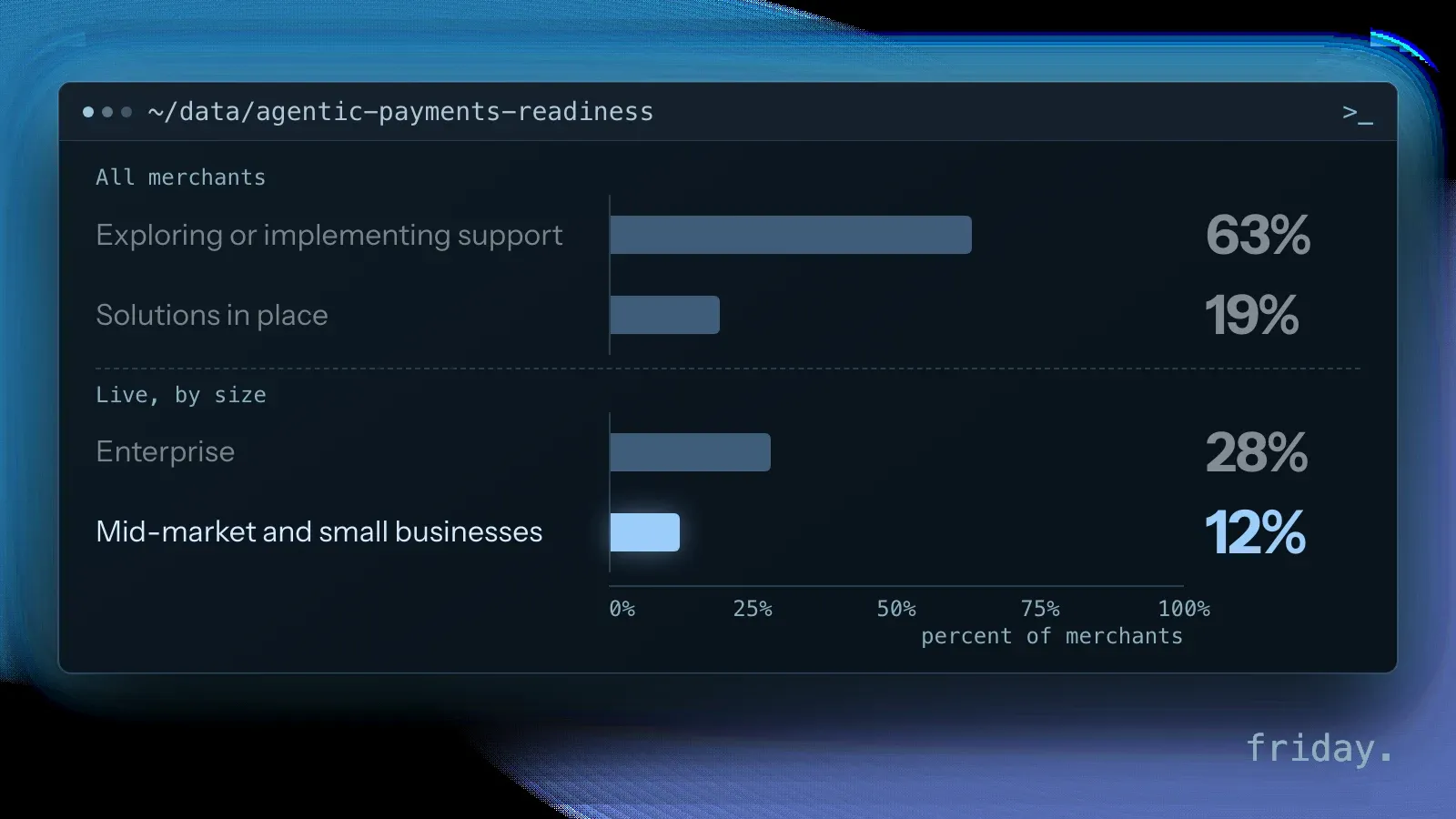
A Visa Acceptance Solutions blog post from June 29, 2026, puts numbers on the agentic commerce gap: "Only 19% of merchants today have solutions in place to accept agent-initiated payments, while 63% are exploring or implementing support." It adds that 28% of enterprise merchants already have agentic payment solutions live, compared with 12% of mid-market and small businesses. Its footnote credits PYMNTS Intelligence, commissioned by Visa Acceptance Solutions, and describes a survey of acquirers across the U.S., Brazil and the UAE.
Fraud, chargebacks and consent in agentic commerce
Every company in this story promises fraud controls. What none of the pages checked spells out is who absorbs the loss when a shopper says the agent bought the wrong thing.
What the networks and processors promise
Visa's 2025 release said "Commerce signals are shared in real-time with Visa, enabling Visa to effect transaction controls and help to manage disputes," and that consumers share spend insights "with their consent." The Nov. 17 release says the Visa Acceptance Platform complements the program with capabilities "including omnichannel acceptance, credential management, fraud protection, and dispute management." Matthieu Barral, VP of Global Partnerships at Checkout.com, said in the same release that "payment infrastructure must keep pace without compromising customer consent or merchant control." Stripe says network tokens help issuers "manage disputes and fraud," and its docs say refunds and reporting on an SPT payment "behave as if you provided the PaymentMethod directly." None of these passages assigns liability for a disputed agent purchase.
Where Regulation Z stops
For US credit cards, the CFPB's Regulation Z caps a cardholder's liability for unauthorized use at "the lesser of $50 or the amount of money, property, labor, or services obtained." Unauthorized use means use by a person who "does not have actual, implied, or apparent authority for such use," and the official commentary says whether authority exists "must be determined under state or other applicable law." When a cardholder gives someone a card and that person goes past the authority granted, the commentary says the cardholder is liable unless the issuer was told the use is no longer authorized. Section 1026.12 covers credit cards and the cardholder's side only. In Friday's reading, a merchant's exposure in a dispute is set by card network and processor rules, and how any of it applies to an agent holding a token is a question for the processor and, in a real dispute, a lawyer.
Four questions for the processor
Before a coffee-gear shop on a hosted checkout takes agentic commerce traffic, its owner can ask the processor four things in writing. Which agent payments are on by default? How does an agent-initiated payment show up in the dashboard and in dispute evidence? Who bears a chargeback when a shopper says the agent overspent? Do fraud rules treat a verified agent differently from a bot? On Stripe, one signal already exists: the event shared_payment.granted_token.deactivated, sent when a token is "(consumed, resolved, expired, or revoked)."
Friday's view: let processors finish the agentic commerce rollout
In Friday's view, a small store gains little by moving first. Visa Agentic Ready is still adding participants through 2027, Stripe's seller tools sit under preview terms, and disputes are open.
Stay with the processor you already pay
Friday's recommendation: let agentic commerce reach you through the processor you already pay, and be wary of a new vendor whose pitch is agent checkout. Both Stripe and PayPal describe agent payments arriving through accounts their merchants already have. A separate agent-payments platform would add a monthly fee, another contract and another dashboard to reconcile, costs worth adding up before signing anything. Ask for transparent pricing in writing: whether an agent-initiated payment costs the same as any other card payment, and whether a new fee applies.
Keep the customer record in your own systems
In Friday's view, the lock-in risk sits in the customer record. Stripe's token details expose limited payment data, such as the card brand, so ask each agent channel which customer contact details reach you after checkout. Keep product data, prices and return policies in a system you own, so any agent channel can be fed from one place and dropped without a rebuild.
A weekly review before any platform
For the next quarter of agentic commerce, Friday's recommendation is modest. Once your processor labels agent orders, tag them in your order export, route them to a weekly review, and compare refunds and disputes against regular orders. A small workflow that connects your store and processor can do that tagging and review, and it scales by adding rules as volume grows.
Getting ready for agentic commerce on your own terms
Visa Agentic Ready brings processors into agent payments, and for a small US store the next steps are a few written questions and a short review loop at the processor it already uses.
Read your processor's agent-payment terms when they arrive, ask the four questions above, and keep agent orders in a weekly review until the agentic commerce dispute questions settle. If you want help setting up that review, tell us which store and processor you use.
Last checked: November 18, 2026, against Visa's press releases of November 17, 2026, December 18, 2025, and April 30, 2025, Visa's Trusted Agent Protocol developer page and Acceptance Solutions blog, Stripe's docs and blog, and the CFPB's Regulation Z.
Facts come from Visa, Stripe and CFPB pages, checked November 18, 2026. Friday has no relationship with Visa, Stripe, PayPal, Adyen or the other companies named. Statements marked as Friday's view, Friday's reading or Friday's recommendation are opinion. This is general information, not legal advice.