
Agentic AI Governance: Gartner's Warning for Small Business
Gartner says written policies cannot physically stop an AI agent from a destructive error. Here is what agentic AI governance looks like for a small business.
In a survey published November 16, 2026, Gartner found 95% of organizations had an agent-related incident in a year, while 15% of leaders had automatic stops.
The research targets large IT teams. Below, several of its controls become settings a small team can use, plus how agents are billed and who keeps records.
Gartner's warning on agentic AI governance
Gartner published two pieces on agentic AI governance this fall: a September 24 article on runtime controls and a November 16 press release with survey figures from 298 IT leaders.
The survey behind the warning
According to Gartner's press release, the survey covered 298 infrastructure and operations (I&O) leaders in the U.S. and U.K. and ran in June and July 2026. It found that 95% of organizations had faced at least one agent-related incident in the past 12 months. In the same survey, 70% of the leaders believed their agents operate within safe boundaries.
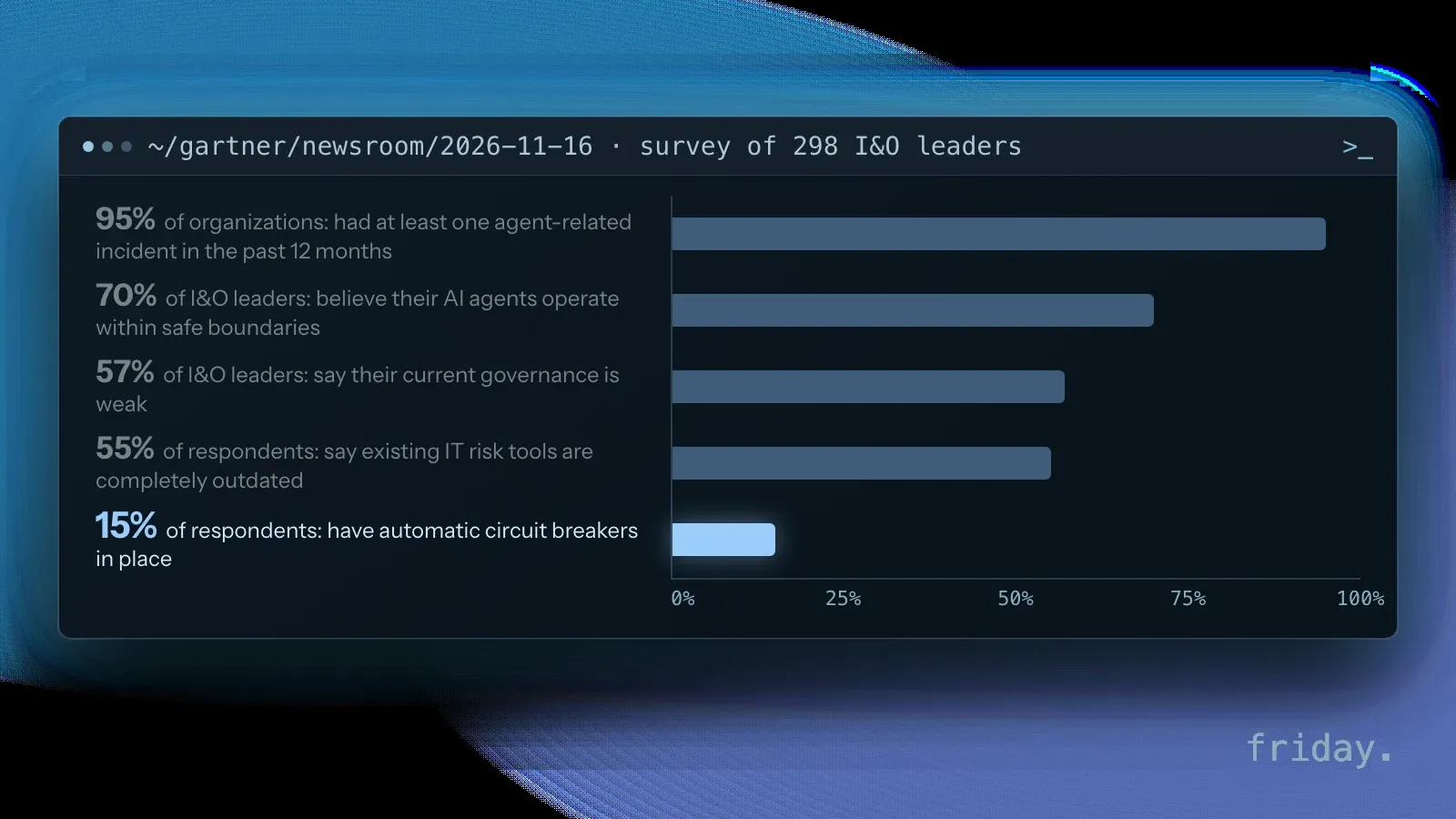
The survey also found that 57% of the leaders call their current governance weak, 55% say their existing IT risk tools are completely outdated, and only 15% have automatic circuit breakers to stop runaway agent errors or infinite logic loops. Gartner's headline prediction: without strong governance, 40% of I&O organizations scaling AI will suffer a business-critical service disruption by 2028.
A prediction for 2029
Gartner's article on agentic AI governance goes further. It predicts that by 2029 at least 70% of organizations with production agentic AI in I&O will have a material service, security or cost incident linked in part to insufficient runtime controls. The gap the survey shows, between incidents and automatic stops, is the gap that prediction is about.
Why written policies cannot stop an agent
The September article explains why the old approach to agentic AI governance fails. Agents act instead of only answering, so a rule in a policy document has nothing to enforce it when the agent acts.
Agents act on probabilities
The article quotes George Spafford, a Gartner vice president analyst: "Written corporate policies cannot physically stop an agent from making a destructive error." Gartner writes that agentic workflows rely on probabilistic reasoning, which makes them susceptible to decisions that can trigger "unauthorized purchases, excessive token consumption or uncontrolled resource usage."
Its answer is a model where agents propose actions and a separate control layer evaluates each action before it runs. That separation of reasoning from execution is the core of agentic AI governance in Gartner's account, and it changes who does the work: the control sits in the system, not in a person reading a policy.
Seven pillars of runtime controls
The press release groups the runtime controls into seven pillars, including identity, guardrails, observability, agentic FinOps and escalation. Identity means a central registry of agents "so nothing runs in the shadows." Observability means recording an agent's reasoning chain and actions, which the article calls "agentic observability and algorithmic auditing." FinOps means session-level spending caps. Escalation means human oversight, with sign-off for high-impact actions.
In Friday's view, the useful part for a small business is that several of these are switches in tools you already pay for, rather than projects. The next section maps them to settings an owner can change.
The runtime controls a small team already has
Gartner writes for teams with an infrastructure department. A small business has the same job with fewer people, and several of these runtime controls are already settings in common agent tools.
Allow, ask and deny
Anthropic's tools expose the three basic runtime controls. Anthropic says users of Claude.ai and Claude Desktop can set permissions such as "always allow, needs approval, block" for each action. Its Claude Code documentation describes allow, ask and deny rules and says "Rules are evaluated in order: deny, then ask, then allow."
Friday's practice for AI agent governance on a new agent: start every tool on ask, and move a tool to allow only after you have read enough of its actions to trust it. A deny rule is the right place for anything the agent should never touch, such as payroll or permission settings.
One agent, one account
Gartner recommends treating each agent as its own identity, with temporary access that is revoked when the task is done. The OWASP entry on excessive agency says the root cause is typically one or more of excessive functionality, permissions or autonomy, and recommends limiting permissions "to the minimum necessary." In Friday's view, the first rule of AI agent governance for a small business follows: an agent never runs on the owner's admin login.
Human oversight for actions you cannot undo
OWASP recommends human-in-the-loop control "to require a human to approve high-impact actions before they are taken." OpenAI's Agents SDK puts human oversight at the tool level, with a needs_approval setting that pauses a run until a person approves or rejects a sensitive tool call. Gartner's article says high-impact and irreversible actions should require explicit human approval.
Friday's list for human oversight in a small business: payments and refunds, emails to customers, deleting records, changing permissions, and anything that signs or commits the business. Reads, drafts and internal summaries can run without human oversight, as long as each action is logged. Our guide to human-in-the-loop AI covers how to design those approval steps.
The bill is part of agentic AI governance
Gartner lists cost incidents next to service and security ones. For a small business buying agents as a service, the bill is where agentic AI governance is felt first.
How agents are billed
Vendors meter agents in different units. Microsoft says Copilot Credits are "the unit that measures agent usage," and that the number an agent consumes "depends on the design of the agent, how often customers interact with it, and the features they use." Salesforce offers Agentforce with Flex Credits, per conversation or per-user licensing, and says you can "Pay per Action as you scale Agentforce."
In Friday's view, a price is transparent only when the vendor can show the billing unit and a worst-case month in writing. Per-action and per-credit pricing looks small in a pilot, so model the bill at ten times your pilot volume before you roll an agent out to the whole team.
Spend caps that stop
Gartner's FinOps pillar calls for "session-level spending caps, to keep token costs under control." Some tools stop at the cap: Anthropic says spend limits set a maximum monthly API cost and that requests stop at the cap. Others keep going: Microsoft says that when consumption exceeds capacity, it allows "some level of overage consumption, similar to a grace period." For an agent that runs unattended, Friday recommends a hard stop over a grace period; a cap is a piece of agentic AI governance you can set in minutes.
AI agent governance: who keeps the records
Gartner's observability and identity pillars end in two buyer's questions: where an agent's records live, and who else can connect an agent to your business systems.
Who owns the logs
OpenAI's Agents SDK documentation says its built-in tracing records "LLM generations, tool calls, handoffs, guardrails" and that "Tracing is enabled by default." Those traces go to OpenAI's backend, and a developer can add a processor to keep a copy. The same page says tracing is unavailable for organizations under a Zero Data Retention policy, so on that setting OpenAI's built-in tracing is off and you need your own log.
Friday's view on AI agent governance from the buyer's side: before you sign, ask whether you can export the full action log, the agent's instructions and its tool connections, in what format, and what happens to them when you cancel. The switching cost of an agent sits in that configuration more than in the model.
Shadow AI includes your agency
In Friday's view, an employee, freelancer or agency that connects an agent to your email, CRM or bank with their own account creates an identity you do not control. Ask any reseller whose account the agent runs under and who holds the admin keys. Gartner's agentic AI governance advice on registries is written for large I&O teams, and the same idea of AI agent governance fits a ten-person office.
Build a small agent or pay for a platform
Friday's view: for one or two clear jobs, a single-job agent with a hard spend cap, per-tool approval, allow, ask and deny rules, and logs you keep covers several of Gartner's agentic AI governance controls without a platform subscription. A custom agent with its own skills and approval rules also keeps that configuration in files you own. A platform earns its price when you run several agents and want vendor support and admin tools you would not build. NIST says its AI Risk Management Framework "is intended for voluntary use," and it works as a checklist either way.
Three settings to make this week
Gartner's warning is written for large IT teams, and the fix scales down. Agentic AI governance for a small business starts with three settings you can make this week.
Set a hard spend cap, put every risky tool on ask, and give each agent its own account with the smallest access it needs. If you want help setting up an agent with those controls built in, tell us which job you want the agent to do.
Last checked: November 18, 2026, against Gartner's September 24 article and November 16 press release, OWASP's LLM06 entry, NIST's AI RMF page, and Anthropic, OpenAI, Microsoft and Salesforce documentation and pricing pages.
Gartner figures come from its November 16, 2026 press release and September 24, 2026 article; vendor settings come from each vendor's own documentation, checked November 18, 2026. Friday has no relationship with any vendor named here. Statements marked as Friday's view are opinion.