
Small Business AI Use: What Bank of America's 84% Shows
Bank of America's 2026 Business Owner Report says 84% of US small and mid-sized owners use AI. What the survey measured and how it compares with Census data.
Ipsos surveyed 1,099 small and mid-sized US business owners in August. Marketing leads the AI uses reported, ahead of data analysis, automation and support.
Federal data tells a different story. The Census Bureau puts AI use at US employer businesses near one in five, as it asks a narrower question of a wider group.
Bank of America puts small business AI use at 84%
Bank of America released its 2026 Business Owner Report on November 17, 2026. Its headline on small business AI use: 84% of the owners surveyed say they use AI in some capacity.
What the 2026 Business Owner Report found
The release, datelined Charlotte, North Carolina, frames the business owner report around cost pressure. It says 91% of owners report higher costs over the past 12 months, up from 77% a year earlier, and 79% raised prices, by nearly 13% on average among those who did. Even so, nearly half (49%) plan to expand and 58% expect revenue to rise over the next 12 months.
Bank of America says 84% of business owners use AI "in some capacity," and that 94% of current AI users say it has "positively contributed to their business in at least one way over the past 12 months." In Friday's view, that second figure covers any benefit at all, so it says more about reach than about depth.
Spending and hiring around the AI numbers
The release ties small business AI use to wider spending plans. It says 89% of owners plan at least one digital investment over the next year, led by AI tools (50%) and marketing technology (43%), and that 61% increased their use of digital tools such as accounting systems, CRM and project management software. Bank of America Institute adds that AI-related spending growth among mid-sized firms was approximately 20% year over year in August, against 18% for small businesses.
Hiring sits next to the technology. Overall, 39% plan to add employees, 49% expect to keep staffing level and 4% expect to cut. Among owners using or planning to use AI, 60% expect it to move employees into new or redesigned roles and 52% expect to hire staff to manage AI tools, while 33% think it will reduce headcount. Among owners planning to hire, customer service representatives lead at 28%, ahead of IT staff (26%) and marketers (25%), and AI skills are the gap owners cite first, at 36%.
Where owners put AI to work
The release breaks small business AI use into four main applications. Each share is a percentage of the owners who already use AI, the 84%, rather than of every owner surveyed.
Four uses lead the list
Among AI users, marketing and advertising comes first at 52%. Data analysis and business insights follows at 41%, then operations and workflow automation at 33% and customer service at 31%. The release does not say whether owners could pick more than one use, though the shares add up to more than 100%.
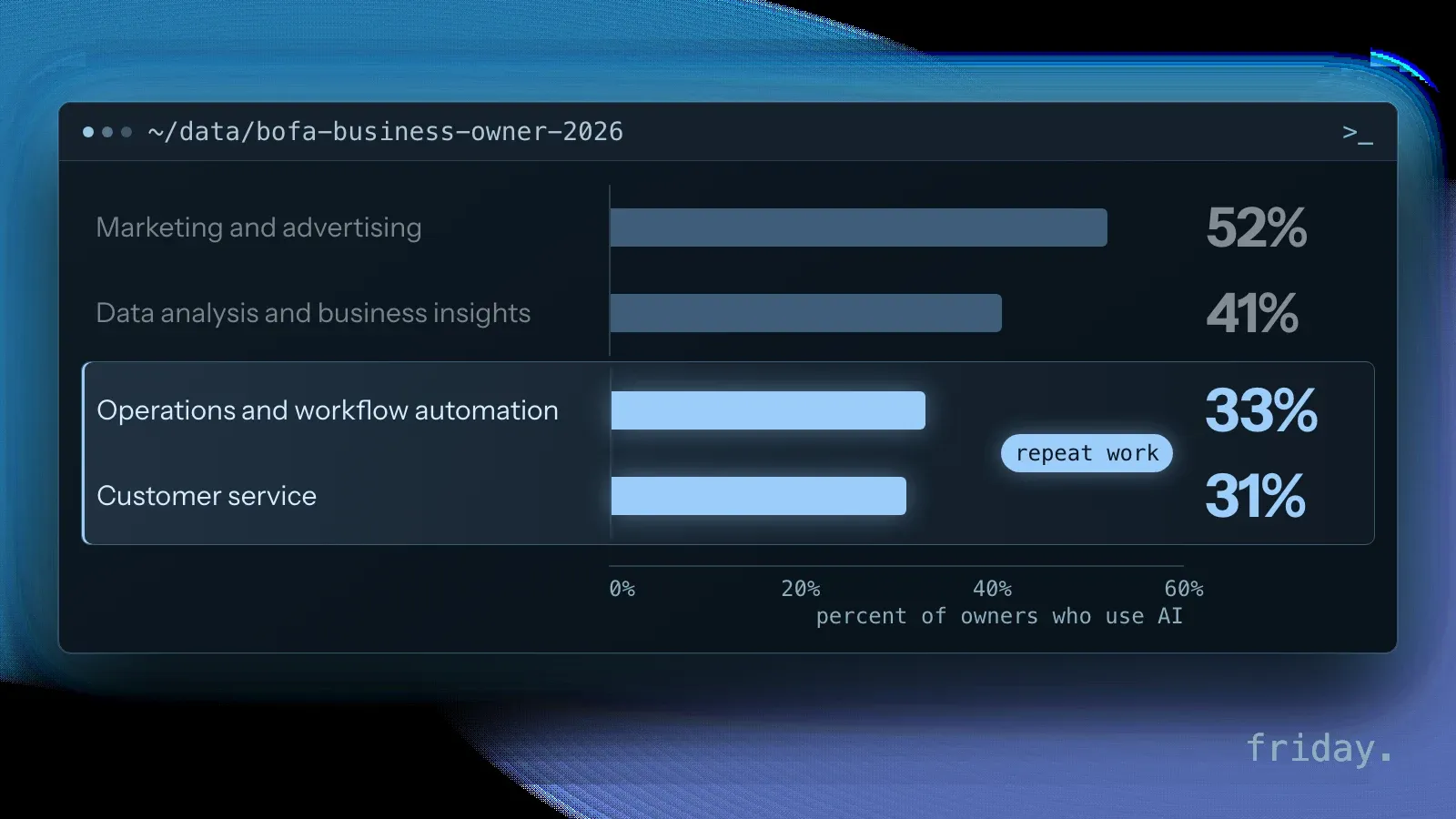
By Friday's arithmetic, applying those shares to the 84% gives about 44% of all surveyed owners using AI for marketing and about 28% using it for workflow automation. The release does not publish those all-owner figures, so treat them as estimates.
Workflow automation comes third
At 33%, operations and workflow automation sits two points above customer service and eight points below data analysis. The release does not define which tasks count under that label, so it can cover anything from scheduling to moving records between systems.
In Friday's view, the two lower bars matter more for small business AI use than their rank suggests. Marketing and analysis lean on judgment, and a person still decides what to publish or what a report means. Workflow automation and customer service are built from steps that repeat: a request arrives, a record changes, a reply goes out. Those are the jobs where AI can take work off a person's day, and the survey shows about a third of AI users already there.
What owners expect AI to return
Among owners using or planning to use AI, 68% expect it to increase sales and revenue over the next year and 66% expect it to improve customer experience. Only 36% expect cost savings through greater efficiency. In Friday's view, that gap is a sign that owners are buying AI for growth stories before they have measured the hours AI saves on routine work.
Who Ipsos surveyed, and what the 84% measures
In Friday's view, a headline rate is only as useful as the question behind it. The business owner report gives its method at the end of the release, and the details narrow who the 84% describes.
Two samples, one combined figure
Ipsos ran the survey online between August 7 and August 20, 2026, using a pre-recruited online sample of business owners. It reached 849 small business owners with annual revenue between $100,000 and $4,999,999 and two to 99 employees, and 250 medium-sized owners with revenue between $5,000,000 and $49,999,999 and two to 499 employees. That makes 1,099 owners in all.
Ipsos weighted the small, medium-sized and combined results to national benchmarks for size, revenue and region. The sample starts at two employees and $100,000 in revenue, so solo owners and shops below that size sit outside it. For small business AI use, that matters: the release reports the AI figures for both groups combined and does not split them between the small and medium-sized samples.
Last year's question was worded differently
The 2025 Business Owner Report, released November 18, 2025, said 77% of owners had integrated AI "into their operations in the past five years." Its list of uses was marketing (50%), content production (38%), customer service (37%) and inventory management (28%). Ipsos fielded that survey from September 11 to September 23, 2025.
The 2026 release asks about use "in some capacity" and lists different categories, adding data analysis and workflow automation. A move from 77% to 84%, or customer service from 37% to 31%, compares two questions, so it is not a clean trend line.
Census data puts small business AI use far lower
The U.S. Census Bureau tracks the same topic with a much larger federal survey. Its rate for small business AI use, and for businesses of every size, sits closer to one in five than to five in six.
What the BTOS asks, and of whom
The Business Trends and Outlook Survey (BTOS) draws on a sample of approximately 1.2 million businesses split into six panels, and its data are representative of all employer businesses in the US economy, excluding farms. Data are released every two weeks. One core question asks whether the business used AI in the past two weeks.
The Census Bureau changed that wording in November 2025. The question was first framed around AI use "in producing goods or services," and it now asks whether a business used AI "in any business function." A second AI supplement, started the same month, measures AI use across 15 business functions, including customer service, marketing and finance.
17% to 20%, and lower for the smallest firms
In a May 26, 2026 story covering BTOS data from December 14, 2025 to May 3, 2026, the Census Bureau said overall AI usage hovered between 17% and 20%, with 20% to 23% of businesses expecting to use it in the next six months. The national rate stood at 19.8% as of May 3, 2026.
Firm size changes the picture. The Census Bureau reported AI use at 37% of firms with at least 250 employees and 32% of firms with 100 to 249 employees. AI use among firms with fewer than 20 employees did not change significantly over the period, and less than 20% of firms with four or fewer employees used it. By sector, Information (39.7%) and Finance and Insurance (33.9%) ran above the national rate, while Retail Trade sat near 14%.
Why both numbers can stand
The two surveys measure small business AI use with different questions put to different groups. Bank of America asks owners in a pre-recruited panel, with at least two employees and $100,000 in revenue, whether they use AI in some capacity. The Census Bureau asks a sample built to represent all employer businesses whether the business used AI in the past two weeks.
In Friday's view, the 84% reads as reach: owners who have tried AI somewhere in the business, including a chat assistant on one person's laptop. The Census rate reads closer to regular use inside the business. For an owner planning small business AI use, the distance between the two is the work still to do. The Census story covers data through May 3, 2026, and newer biweekly BTOS tables were not part of this check.
Choosing the next workflow by counting repeated tasks
The four categories in the report are broad. Turning them into a decision means looking at your own week and finding the steps that a person repeats the same way every week, with little judgment.
Count repetitions before choosing a tool
Friday's recommendation: list the tasks that fall under the four small business AI uses in the business owner report, then count how many times each runs in a week, how many steps it takes and how many systems it touches. A monthly campaign plan scores low. Logging invoices, answering order-status emails and following up on quotes score high, because the steps repeat. Pick the highest count with clear rules as the first workflow automation, and leave judgment-heavy work with people.
Picture a six-person property office
Picture a six-person property management office that gets maintenance requests by email. Each one is copied into a spreadsheet, a vendor is texted and the tenant gets a reply. That is one repeated sequence touching three systems. A small workflow can read the request, log it, draft the vendor message and the tenant reply, and hold both for a staff member to approve. It covers the customer service and workflow automation uses at once.
Weigh a subscription against a small build
In Friday's view, the real bill for AI includes lines that never appear on a pricing page: per-seat add-ons charged to a whole team for a task one person runs, setup fees, agency retainers and connector charges. Before you sign, ask for published pricing, a data export and what happens to your prompts and records if you cancel. When one task has clear steps across two or three tools you already pay for, a small AI workflow built on your existing tools can cost less than a new platform and leaves you owning the accounts, keys and documentation. A platform earns its fee when you need dozens of workflows, a large team on them and support you cannot provide yourself.
Measure one workflow before adding the next
Friday's recommendation: run the first workflow for 30 days and track time saved, errors caught and replies that needed a human fix. With only 36% of owners using or planning to use AI expecting cost savings, that record is what turns small business AI use from a growth hope into a number you can check. Then go back to the list. Our guide on what to automate first walks through the scoring in more detail, and the 36% skills gap the report found is a reason to keep staff in the loop while the workflow beds in.
What the 84% means for your next step
Bank of America's survey shows AI has reached 84% of the owners it asked; the Census rate shows how far regular use has to go. In Friday's view, the space between is a list of repeated tasks.
Begin your own small business AI use with the task your team repeats week after week, measure it and keep the parts you own. If you want help choosing and building that first one, send us the task your team repeats every week.
Last checked: November 18, 2026, against Bank of America's 2026 and 2025 Business Owner Report releases on PR Newswire and the U.S. Census Bureau's BTOS program page and AI Use at U.S. Businesses story.
Survey figures come from Bank of America's releases and U.S. Census Bureau pages, sources checked November 18, 2026. Friday has no relationship with Bank of America, Ipsos or the Census Bureau. Statements marked as Friday's view or Friday's recommendation are opinion.