ChatGPT Shopping for Small Stores: Feeds, Checkout, Returns
ChatGPT shopping lists products from feeds, Shopify and Etsy, then hands the buyer to the store's checkout or Etsy's. How a small US store gets listed and paid.
A store owner needs four answers: what replaced ChatGPT Instant Checkout, how to sell on ChatGPT, which feed fields OpenAI wants, and what is owed after a sale.
Google, Microsoft and Amazon run AI shopping agents, and Stripe and Shopify sell plumbing. Each part names who holds the order, payment and customer record.
What ChatGPT shopping is and how a listing appears
ChatGPT shopping is the product search inside ChatGPT: a shopper describes a need, ChatGPT compares options with images and prices, and the purchase goes to the seller's checkout or Etsy's.
From a shopper's request to a product card
OpenAI's partner playbook describes the journey in four steps. The customer describes what they need, ChatGPT looks for relevant options, the customer compares them, and the journey moves to the seller's website through ChatGPT's browser or to a plugin the seller built. OpenAI's own sample request is "Find a carry-on that fits under the seat." On the merchant page, results appear as rich cards: "Shoppers browse products through rich results with images, pricing, and key details in one place."
The shortlist is personal. OpenAI says ChatGPT "helps match your products to people based on shopper preferences and past interactions." Two shoppers who type the same request can see different products, so there is no fixed ranking to track. What a store can control is the data ChatGPT shopping reads about each product.
Where ChatGPT gets its product data
OpenAI lists three kinds of input: "ChatGPT can use information from the public web, private API integrations, and, for retail, merchant product feeds." For a small store, ChatGPT shopping draws on your public product pages, your catalog as a feed (sent directly or through Shopify or Etsy), and what other sites publish about your products.
A feed is optional. OpenAI's merchant FAQ answers the question of whether a feed is needed when ChatGPT already crawls your site: "No, but feeds give you greater control over how your products appear, helping ensure more accurate and up-to-date information." A crawled page can show ChatGPT shopping yesterday's price; a feed you refresh shows today's.
Live for US shoppers first
OpenAI's merchant page says "Shopping is currently live in the U.S. and will expand to additional regions over time." The feed schema matches that: the standard upload "currently targets the US," and other markets wait until OpenAI confirms them for your integration. A store that ships only inside the US loses nothing here. A store that also sells to Canada should treat ChatGPT shopping as a US channel for now and keep its cross-border offers on its own site.
What happened to ChatGPT Instant Checkout
ChatGPT Instant Checkout let shoppers pay inside the chat. OpenAI now says it is moving away from that flow toward merchant-owned checkout, while Etsy still describes its own guest checkout.
Merchant-owned checkout replaced the in-chat purchase
OpenAI launched ChatGPT Instant Checkout on September 29, 2025, built on the Agentic Commerce Protocol with Stripe. US users could "buy directly from U.S. Etsy sellers right in chat," with Shopify merchants announced as coming soon, and the launch post said it "supports single-item purchases." Merchants already ran orders, payments and fulfillment on their own systems.
OpenAI's merchant FAQ is direct about the end of ChatGPT Instant Checkout as a standalone flow: "We're moving away from a standalone Instant Checkout experience in ChatGPT and prioritizing better shopping discovery and merchant-owned checkout experiences." Purchases "are completed on merchant-owned websites or apps."
OpenAI gives no reason for the change. In Friday's reading, conversational commerce struggles when product data, transaction clarity and delivery are weaker than the chat promises. A checkout run by the store keeps its own shipping rules, discount logic and fraud checks.
Fees after ChatGPT Instant Checkout
At the launch of ChatGPT Instant Checkout, OpenAI wrote that "Merchants pay a small fee on completed purchases." Today the merchant FAQ says "There are no fees on purchases that start in ChatGPT." The page also promises merchants can "Send shoppers to your site or app by default, with no fees for purchases made on your site or app." Your card processor still charges its normal rate on a ChatGPT shopping order, the same as any other sale.
Shopify gives the same answer for its stores. Its March 24, 2026 announcement says products are discoverable in ChatGPT "with no separate integrations, no apps, and no transaction fees beyond standard processing rates." In Friday's view, without ChatGPT Instant Checkout, ChatGPT shopping is a referral channel with no commission today, which is a better deal than a marketplace that takes a cut of every order. Terms can change, so read the merchant page again before you plan margins around it.
What is left of ChatGPT Instant Checkout in the feed
The feed schema still carries a checkout section. OpenAI warns that "Checkout requires a separately enabled integration. Setting an eligibility flag does not complete checkout onboarding." The flag is_eligible_checkout is "Conditionally required to opt into checkout," and true "opts in only when search eligibility is also true and checkout is enabled for the integration." Two seller URLs, seller_privacy_policy and seller_tos, are each "Conditionally required for checkout."
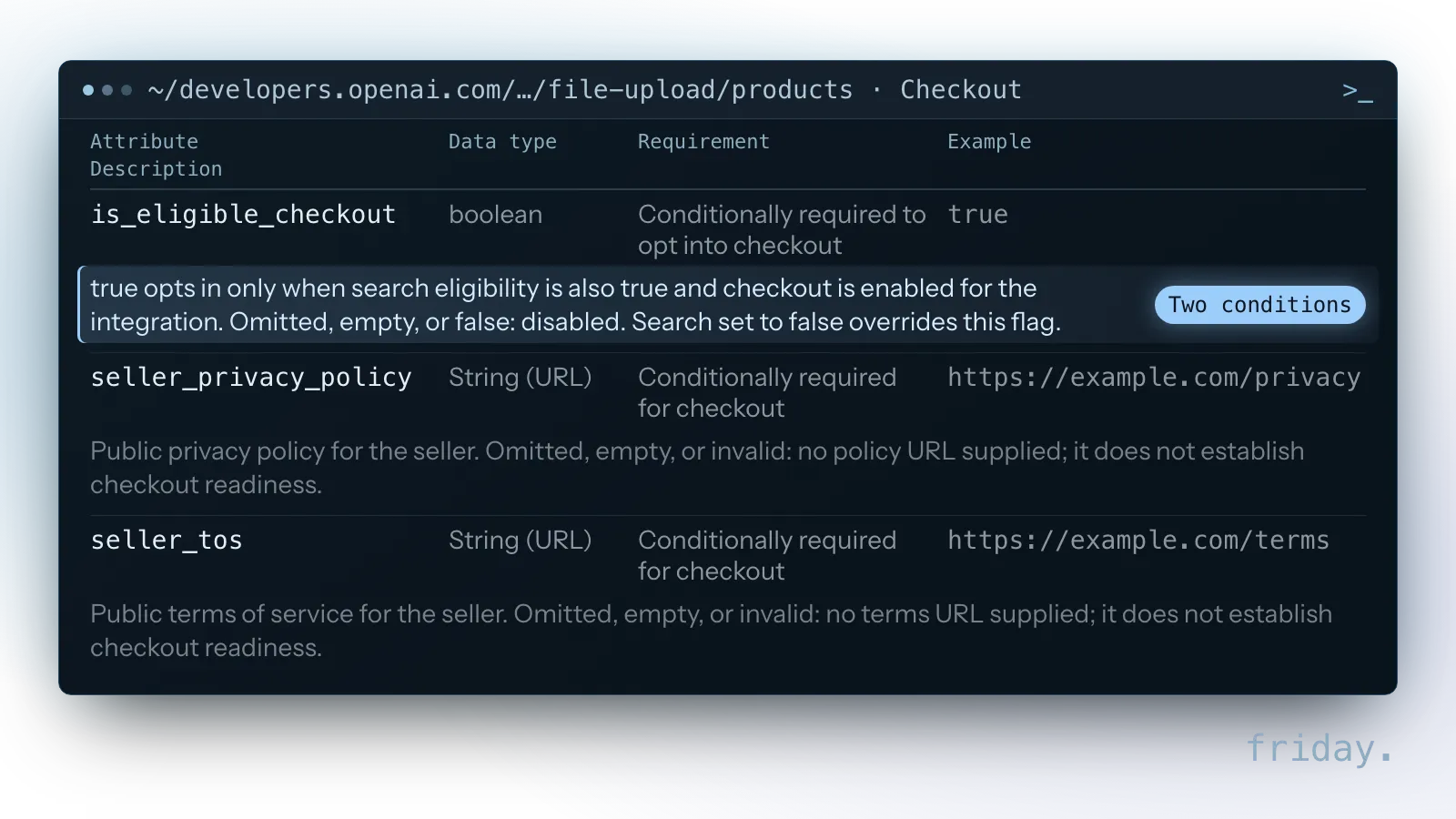
Setting the flag alone will not turn in-chat checkout on for your store, and setting search eligibility to false overrides it. Leave it off unless OpenAI enables checkout for your integration, and plan ChatGPT shopping as a path to your own checkout.
ChatGPT Wallet on your existing checkout
Payment moved to the store's checkout too. OpenAI's payments guide says "Customers can use ChatGPT Wallet to pay on your website or use an existing saved payment method," and adds that "Your business handles the order, fulfillment, customer support, and fraud decisions." No Wallet-specific integration is required.
You receive a network token in place of the full card number. The shopper consents only to that one purchase, so do not save the credential for a later order. Subscriptions are allowed if your checkout already supports recurring billing and you collect consent for recurring charges.
Three ways to sell on ChatGPT from a small US store
How you sell on ChatGPT depends on where your catalog already lives. Shopify and Etsy stores are integrated without an application; every other store applies to OpenAI or uploads a product feed.
Shopify stores: Agentic Storefronts are on by default
Shopify's Help Center says "Agentic storefronts is active by default for eligible stores, so you don't need to turn it on." Its March 24, 2026 news post announced the ChatGPT launch. Shopify calls ChatGPT "a discovery-focused referrer platform": buyers pay on your own store checkout in ChatGPT's in-app browser, or in a new tab on ChatGPT web.
Eligibility has three parts. Products must qualify for Shopify Catalog, the store must complete its Terms of service, Privacy policy and Return and refund policy in Settings > Policies, and each channel adds its own rules, such as the countries you sell to. You also accept Shopify's Agentic Storefronts Supplemental Terms of Service. You choose channels in Sales channels > Agentic in the Shopify admin.
Shopify's developer changelog adds that the Agentic Storefronts page lets you "track performance across all major AI channels, see which queries you rank for, and get recommendations to improve your product data." If you run a Shopify store, you can already sell on ChatGPT; the work is reviewing that page and fixing the product data it flags.
Etsy shops: the order stays an Etsy order
OpenAI's merchant page says "If you sell through Shopify or Etsy, your catalog is already integrated, and no additional setup or application is required." Etsy's Help Center says it partnered with OpenAI, Google and Microsoft "to allow some Etsy listings to be purchased directly in ChatGPT, Gemini, Google AI Mode, and Copilot."
The buyer checks out as a guest with Etsy, pays in US dollars only, and cannot use Etsy gift cards or coupons. Questions about order status, shipping address changes and cancellations go to the seller through Etsy.
Etsy's page says that "When you make a purchase through ChatGPT, Gemini, Google AI Mode, or Copilot, you will check out as a guest with Etsy." OpenAI's merchant FAQ says purchases "are completed on merchant-owned websites or apps." As of Nov 19, 2026, the two pages read differently, and neither says where Etsy's checkout opens. For an Etsy seller, the practical answer is the same either way: the buyer pays Etsy, and the order is an Etsy order. One catch: the order is not linked to the buyer's Etsy account until they connect it with the same email, and Etsy says they need that link to send a Help with Order request.
Every other store: how to sell on ChatGPT with a feed
For a WooCommerce, BigCommerce or custom store, OpenAI's merchant page offers an application to share your product feed. The form asks for first and last name, work title, LinkedIn, work email, company, headquarters country, a link to your merchant website and your primary product categories, from Arts, Media & Learning to Travel. You tick the interest "Integrating my product feed so my products show up in search results on ChatGPT," and there is an optional box for "Our product feed is ready to go and meets OpenAI's specifications." A required field, "Feed Size - Unique SKU Count," offers bands from 0–1M through 1–10M, 10–50M and 50–100M to 100M+; a small store picks 0–1M. The page says applicants join a waitlist and that a self-serve merchant platform is coming. OpenAI's developer guide, checked the same day, already describes that route: start in Business Hub, verify your identity, then upload products by manual upload, a hosted HTTPS URL or SFTP.
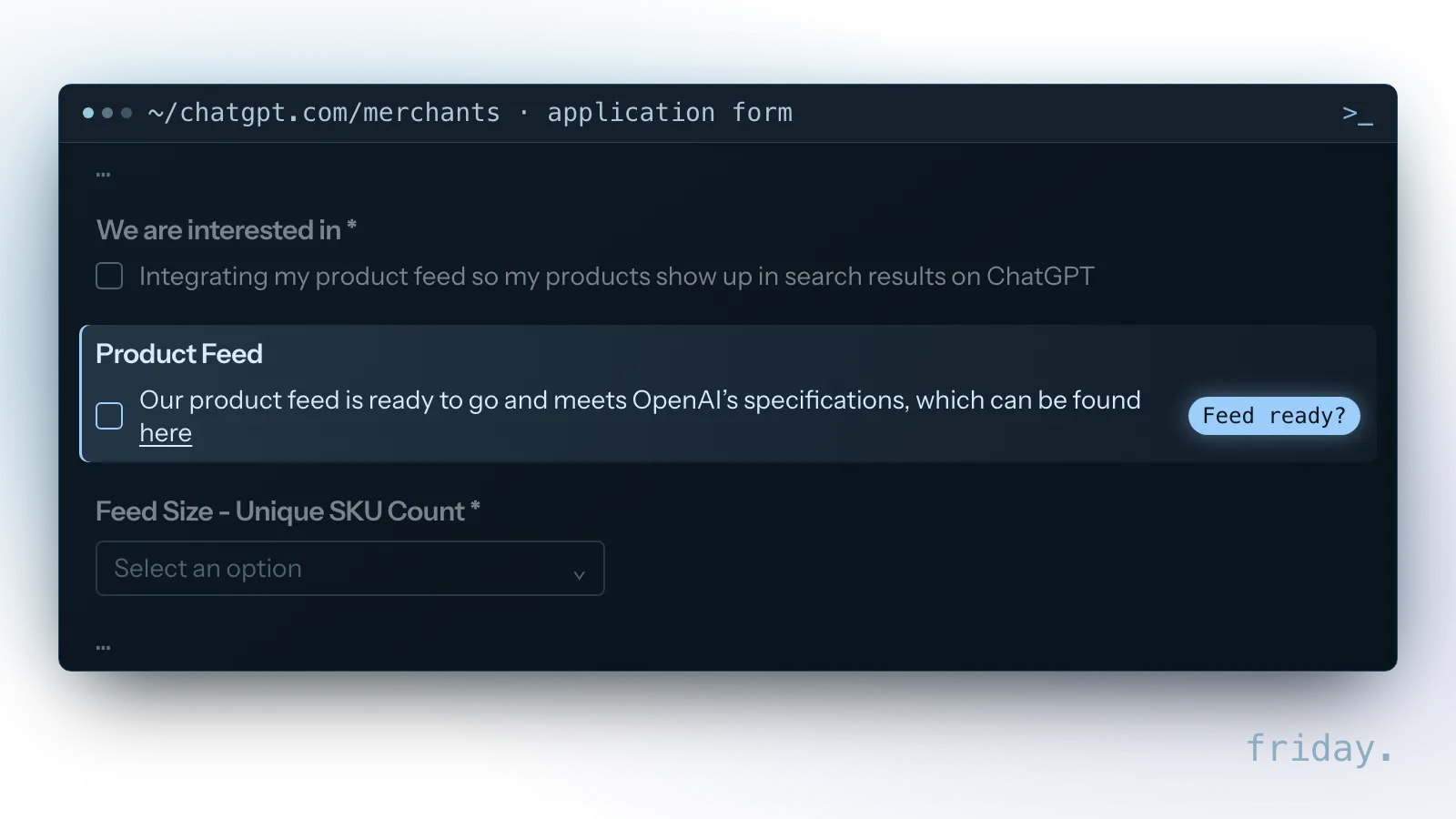
From one of these platforms, try Business Hub first and keep the application as a fallback. A second route runs through Shopify: its Agentic plan lets brands that do not use Shopify for their store list products in Shopify Catalog and reach the same AI channels. Ask Shopify for the US rates before you sign up.
When to sell on ChatGPT through an app
OpenAI's FAQ puts product feeds first and calls apps optional, suited to larger merchants who want more control over the shopping and purchase experience. The partner playbook says a plugin "takes more integration work" than letting ChatGPT's browser use your existing site. A store with a few hundred products gets more from a clean feed than from an app.
The product feed behind ChatGPT shopping
A feed is a file with one row per item or variant. OpenAI's schema asks for nine product fields and two country fields, with optional fields for variants, shipping, returns and reviews.
The required fields, in OpenAI's own example
The nine product fields are item_id, title, description, url, brand, seller_name, image_url, availability and price, plus target_countries and store_country. OpenAI asks for a real brand and seller name, titles up to 150 characters and plain-text descriptions up to 5,000. This is OpenAI's minimal record for a ChatGPT shopping feed, one line of JSONL:
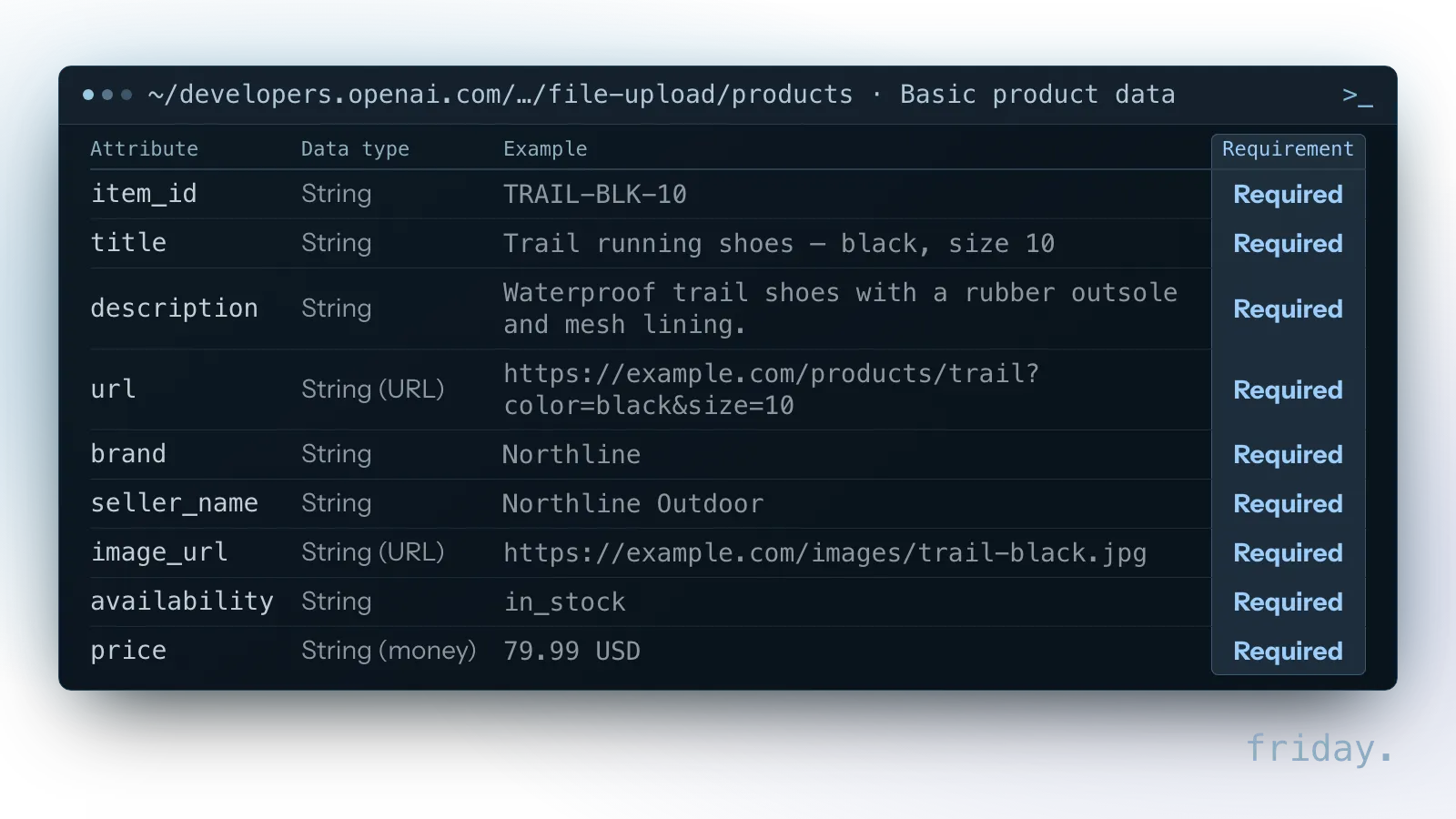
{"item_id":"MUG-350-BLUE","title":"Blue ceramic mug, 350 mL","description":"Dishwasher-safe glazed ceramic mug with a handle.","url":"https://example.com/products/mug-blue","brand":"Northline","seller_name":"Northline Home","image_url":"https://example.com/images/mug-blue.jpg","price":"18.00 USD","availability":"in_stock","target_countries":["US"],"store_country":"US"}Source: OpenAI, Product feed schema, minimal example. Search eligibility defaults to on and checkout to off.
Stable IDs, variants and GTINs
Each variant gets its own row with a distinct item_id, a shared group_id, listing_has_variations set to true and a variant_dict of the chosen options. Keep the IDs stable when price, stock or images change, and OpenAI's rule is blunt: "Never include price in an offer ID." For example, a candle shop with three scents in two sizes sends six rows under one group ID.
A GTIN must be exactly 8, 12, 13 or 14 digits with a valid check digit, and zeros at the start stay. If a handmade product has no GTIN, leave the field out; the schema says a part number goes with brand and should not be made up to fill the gap. Availability must be explicit: an empty or unrecognized value rejects the row, and unknown is the honest answer when stock is unclear.
Shipping, returns and review fields
The optional fields carry the promises a shopper asks about. An empty shipping_price means the charge is unknown; it does not mean free. Returns take three separate fields: accepts_returns, return_deadline_in_days and a return_policy URL. For a final-sale item, OpenAI says to send accepts_returns=false and omit the window.
Reviews use review_count and star_rating for the product itself; store reviews are excluded, and a product with no reviews gets no rating. These fields let ChatGPT shopping answer "can I return it?" without sending the shopper to hunt through your policy pages.
Keeping price and stock current
OpenAI's feed guide sets the limit of a feed: "The feed does not update a cart or confirm a purchase. Your live website or plugin still checks the current offer when a customer acts." A feed that still says in_stock for a sold-out item sends a ready buyer to a dead page.
Stripe's seller guide gives a cadence for AI shopping agents: product data once a day, inventory and pricing every 15 minutes. A slow-moving catalog can refresh less, but on the same day a price changes or a product sells out.
Let AI shopping agents reach your product pages
Feeds are one input. ChatGPT also reads public pages and can send its cloud browser to your checkout, so robots.txt and firewall settings decide whether a ready shopper gets through to pay.
OAI-SearchBot and robots.txt
OpenAI's crawler overview separates search from training. OAI-SearchBot surfaces sites in ChatGPT search, and "Sites that are opted out of OAI-SearchBot will not be shown in ChatGPT search answers, though can still appear as navigational links." GPTBot collects content for model training, and each setting is independent. A store can allow the first and block the second:
User-agent: OAI-SearchBot
Allow: /

User-agent: GPTBot
Disallow: /
Source: user-agent names from OpenAI's Overview of OpenAI Crawlers, checked Nov 19, 2026. OpenAI says a robots.txt change can take about 24 hours to reach search results. Check your file for an old rule that blocks every bot.
Firewalls and ChatGPT's cloud browser
When a shopper asks ChatGPT to use your site, a browser running in the cloud visits it, and OpenAI warns that "your firewall may block or interrupt the visit." Akamai, Cloudflare, HUMAN and Vercel verify ChatGPT's request signatures automatically, per OpenAI's agent access page; other providers need a manual setup.
Fraud tools are the second trap. OpenAI's payments guide says the cloud browser can set off bot detection "and cause purchases to fail," and it is rolling out user signals through the Forwarded HTTP header. Ask your fraud or checkout provider whether it reads that header before you count on ChatGPT orders.
AI shopping agents beyond ChatGPT
ChatGPT is one of several AI shopping agents. Google, Microsoft and Amazon run their own, and Stripe and Shopify sell the plumbing that lets one catalog reach all of them from one place.
Google AI Mode and Gemini: the native_commerce attribute
Google's Merchant Center Help describes a native_commerce attribute with a checkout_eligibility value. Set to true, it shows a Buy button so shoppers can buy "directly within interfaces such as Gemini and AI Mode in Google Search without being redirected to an external website." Google recommends a supplemental feed so your primary feed stays untouched.
The checkout runs on the Universal Commerce Protocol, which Shopify announced on January 11, 2026 as co-developed with Google. Google's UCP page tells merchants "You remain the Merchant of Record" and offers a waitlist. Shopify stores reach AI Mode and Gemini through Agentic Storefronts; other stores start in Merchant Center.
Microsoft Copilot through Shopify
Shopify's January announcement added Copilot Checkout, an embedded checkout inside Microsoft Copilot. Its Help Center says that for Google AI Mode and Gemini, Copilot and Meta surfaces, a store with direct checkout activated lets buyers pay in "the channel's Shopify-powered direct checkout without having to leave the AI channel." For a Shopify store, Copilot is one more switch on the same Agentic page.
Amazon Buy for Me
Amazon announced Buy for Me in April 2025 as a beta in its Shopping app for a subset of US customers. It buys a product from a brand's own website for the shopper when Amazon does not sell it. Amazon passes the shopper's encrypted name, address and payment details to complete checkout on the brand's site. Amazon also says "Delivery, returns and exchanges, and customer service are managed by the brand store," so the order lands in your store like any web order and the support work stays yours.
Stripe's Agentic Commerce Suite and ACP
The Agentic Commerce Protocol, which Stripe and OpenAI developed, is open source under Apache 2.0, and its site says "businesses maintain their customer relationships as the merchant of record." Implementing it does not list you anywhere; each AI platform runs its own admission process.
Stripe's Agentic Commerce Suite does the work for a store on Stripe: you share a CSV catalog, choose agents, and Stripe "manages checkout, processes payments, and notifies you of orders." It is available in the US, Canada and select European countries. Friday's caution: with Stripe-managed checkout, or with Shopify's Agentic plan for a store not on Shopify, the checkout or the catalog lives on their platform, so leaving later means rebuilding that piece. Ask Stripe what it charges per agent order before you enable it; the network side of that payment is covered in our note on agentic commerce at the payment layer.
Returns, order data and who owns the customer
Whichever way you sell on ChatGPT or through other AI shopping agents, the store stays merchant of record and handles returns. What changes is how much customer data reaches you.
Who holds the order in each route
| Route | Where the buyer pays | Where the order lands | Who answers the buyer |
|---|---|---|---|
| ChatGPT shopping, store with its own site | Your website or app | Your store | Your business |
| Shopify Agentic Storefronts | Your Shopify checkout in ChatGPT's in-app browser; direct checkout in Gemini, Copilot and Meta when activated | Shopify admin, with ChatGPT referral attribution | Your business |
| Etsy listing in ChatGPT, Gemini or Copilot | Etsy guest checkout, USD only; Etsy says the purchase happens in the AI channel | Etsy shop | The seller, through Etsy |
| Google AI Mode or Gemini Buy button | Inside Google's interface | Your store, as merchant of record | Your business |
| Amazon Buy for Me | Your website, filled in by Amazon's agent | Your store | Your business |
| Stripe Agentic Commerce Suite | Stripe-managed checkout | Your endpoint or the Stripe Dashboard | Your business |
Returns and refunds
Your return policy applies to every order from AI shopping agents, so the feed fields and the policy page must say the same thing. Stripe's order guide says that if you already use its Checkout Sessions API or Payment Intents API, "your existing refund flow works without changes for agentic checkouts," with refunds and disputes handled on the Transactions page or through the Refunds API. Etsy routes cancellations through the seller's normal Etsy tools, wherever the shopper found the listing.
For example, a six-person home goods store on Shopify would handle a return from a ChatGPT shopping referral in the same admin it already uses, with no separate return desk.
Order attribution and the customer record
Shopify's Help Center says that for AI channel orders "you retain full ownership of the customer relationship and post-purchase experience," and the orders show in your admin with channel or referrer attribution. Its March post adds that merchants stay "the merchant of record." On Etsy, the buyer is an Etsy guest, so the relationship stays on Etsy's terms.
A sale from AI shopping agents still needs the steps you run for any new customer: a confirmation email that names your store, a clear return path and, where the buyer opts in, marketing consent recorded in your own system. The agent found the buyer; keeping them is the store's job.
Catalog quality and logistics decide the sale
AI shopping agents repeat what your data says about price, stock, shipping and returns. When that data is thin or stale, the product drops out of answers or the order fails after the click.
Discovery loss can happen quietly
A catalog can look complete on your storefront and still be hard for an agent to interpret: missing materials, vague sizes, a title that names a collection instead of the product. Nothing breaks. The store gets fewer ChatGPT shopping referrals, and the cause hides inside a catalog that looks healthy in your own dashboard.
OpenAI's merchant page frames the fix in plain terms: "Richer data helps your products surface with more accurate information when shoppers compare options." Shopify's Agentic Storefronts page shows which queries your products rank for. The weekly review below includes two ChatGPT shopping requests your buyers would type; compare each answer with your product page.
Shipping and stock promises AI shopping agents repeat
Agentic commerce is a logistics problem as much as an interface one. If the feed says $5 shipping and the checkout says $12, the buyer leaves. Keep the feed's shipping charge, the return window and stock status tied to the same source your checkout uses.
For a small store, that means one scheduled export from the store platform, with no hand-edited spreadsheet in between. A feed someone updates by hand on Fridays will be wrong by Tuesday.
Custom, wholesale and made-to-order items
Negotiated and custom orders stay inside your own systems. An AI shopping agent can help a buyer find a made-to-order table or a wholesale case price, but a quote with a deposit, a lead time and a delivery window needs a person or a workflow you control. Mark such items as pre-order or leave them out of the feed, and send the buyer to a quote form.
Friday's view: one feed check before any platform
A small store does not need a new platform to sell on ChatGPT or through other AI shopping agents. It needs accurate product data, an open site and a weekly look at what the agents say.
What a small store can skip for now
If you sell on ChatGPT through Shopify or Etsy, skip paid feed tools and agency retainers that promise placement in ChatGPT shopping. OpenAI says richer product data helps products surface, and that data is yours to fix; no paid tool controls the personalization or the third-party pages ChatGPT also reads. Skip building a ChatGPT app until a feed is live and earning referrals. Skip any plan built on ChatGPT Instant Checkout, since OpenAI has moved away from it, and send ChatGPT shopping buyers to your own checkout.
A 30-minute weekly review
Friday's recommendation is a short routine owned by one person. Check AI referrals and orders in your store reports, compare five feed rows with the live product pages, and run two shopper prompts in ChatGPT shopping. When the routine outgrows a person, an agent with a narrow, written skill can run the comparison and flag mismatches for a human to fix.
ChatGPT shopping FAQ for store owners
Five questions store owners ask about ChatGPT shopping and how to sell on ChatGPT, answered from OpenAI, Shopify, Etsy and Stripe pages checked on November 19, 2026.
Can I pay to appear in ChatGPT shopping results?
OpenAI runs a separate ads product: its Ads documentation says to "Use product feeds to create ads from your catalog," with an ad account and an Advertiser API key. In the feed, the ads flag is independent of search eligibility, so organic listing and ads are two separate choices.
Can shoppers still use ChatGPT Instant Checkout?
OpenAI says it is moving away from a standalone ChatGPT Instant Checkout and that purchases complete on merchant-owned websites or apps; Etsy's Help Center still describes Etsy guest checkout for its listings. Checkout in the feed requires a separately enabled integration that a flag alone does not turn on.
What does it cost to sell on ChatGPT?
At the ChatGPT Instant Checkout launch, OpenAI said merchants paid a small fee on completed purchases. Today its merchant FAQ says there are no fees on purchases that start in ChatGPT, and your card processor charges its normal rate.
Do I need a feed to sell on ChatGPT from Shopify or Etsy?
No. OpenAI says Shopify and Etsy catalogs are already integrated with ChatGPT shopping. Shopify stores manage the channel on the Agentic Storefronts page, and Etsy listings flow through Etsy's own partnership.
Is ChatGPT shopping available outside the US?
OpenAI says ChatGPT shopping is live in the US and will expand to other regions over time. The standard feed upload targets the US until OpenAI confirms other markets for an integration.
Start with one feed check this week
Pick your ten top-selling products and compare what ChatGPT shopping shows with your own pages for price, stock, shipping and return terms. Fix the data wherever the two differ.
Then check that OAI-SearchBot and ChatGPT's cloud browser can reach your site. A store that passes both checks is ready to sell on ChatGPT, and the same data serves Google's and Microsoft's AI shopping agents.
If you want help wiring your catalog, orders and returns into one weekly routine, book a call to map your store's AI shopping setup.
Last checked: November 19, 2026, against OpenAI's merchant page, commerce guides, product feed schema and crawler overview, OpenAI's Instant Checkout launch post, Shopify's Help Center, news posts and developer changelog, Etsy Help, Google Merchant Center Help and UCP page, Amazon's Buy for Me page, and Stripe's agentic commerce docs.
Program status, eligibility and fees come from OpenAI, Shopify, Etsy, Google, Amazon and Stripe pages, checked November 19, 2026. Friday has no relationship with any vendor named here.