
How to Fact-Check AI Content Before It Goes Out to Customers
AI drafts sound just as sure when they are wrong. Fact-check AI content with five steps, claim by claim, before it reaches a customer, a proposal or your site.
Fact-checking AI content means testing each claim against a source outside the draft: a number, a date, a quote, a citation or a promise about your business.
The routine covers splitting a draft into claims, tracing each to its original source, comparing the wording, ranking by risk and keeping a record to reuse.

Why AI drafts get facts wrong
A language model writes plausible text from patterns in its training data. Unless a connected tool looks a fact up, nothing in that process checks whether a sentence is true.
What NIST calls confabulation
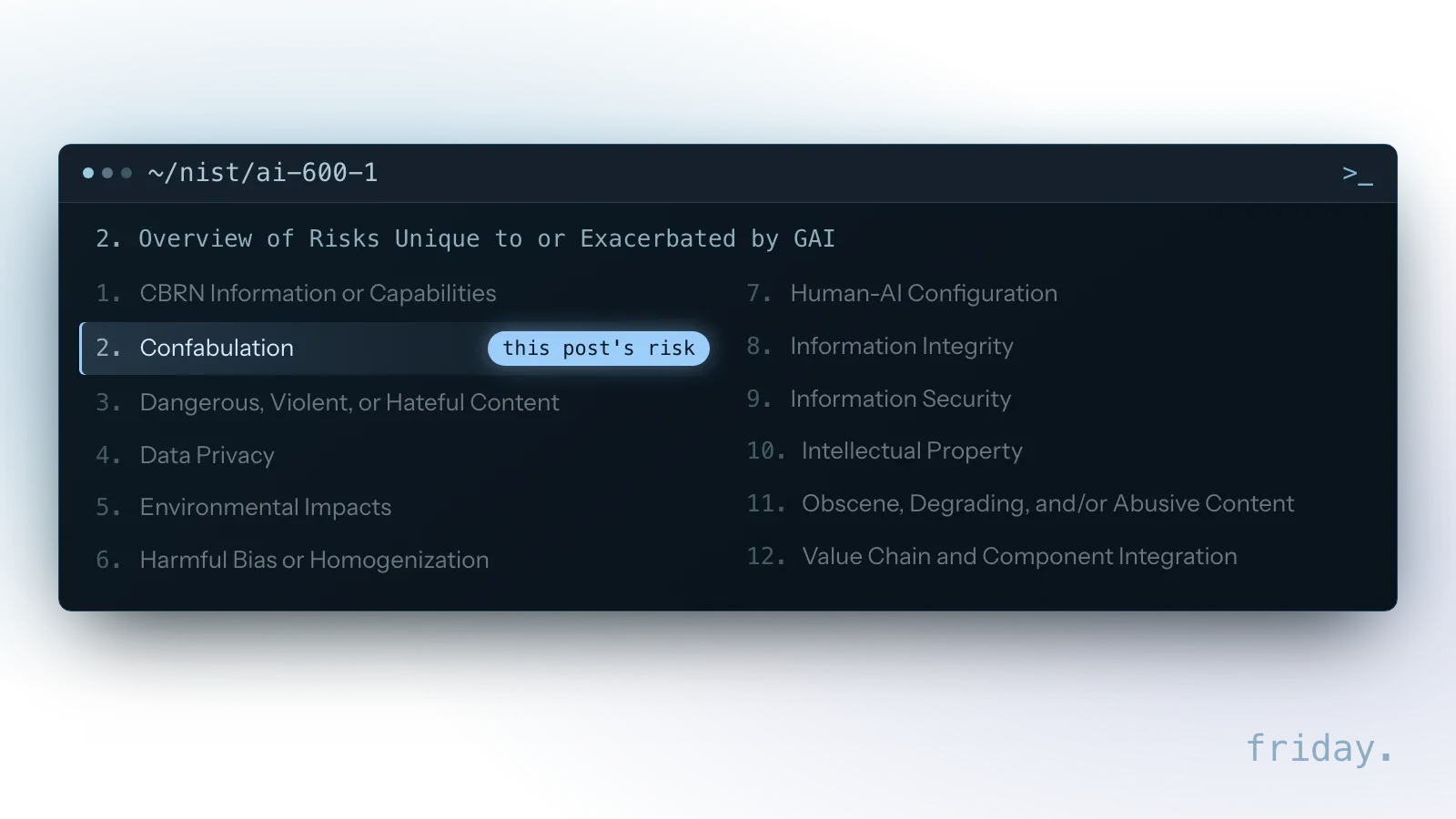
NIST's Generative AI Profile (NIST AI 600-1, July 2024) lists confabulation as one of 12 risks unique to or exacerbated by generative AI and defines it as the production of confidently stated but erroneous or false content, known colloquially as hallucinations or fabrications. NIST calls confabulations a natural result of the way generative models are designed: they predict the next word from the statistical patterns in their training data, and that can produce accurate text or text that is factually inaccurate or internally inconsistent.
The profile adds a warning that applies directly to editing. Outputs may include confabulated logic or citations that purport to justify the answer, and those can lead people to trust it. A list of sources at the end of a draft is part of the draft, so it needs checking too.
Three patterns to watch for
The routine is built to catch three patterns:
- Out-of-date knowledge: training data stops at a cutoff date, so prices, product versions, laws and people's roles may have changed since.
- Filling gaps: when a prompt asks for a statistic or a source the model does not have, it may produce one that fits the sentence.
- Blending: details from similar companies, products or studies get merged into one confident statement.
What search and document tools change
Tools that let the AI search the web or read your documents give it something real to quote, but they do not remove the problem. The model can still misread a page, quote the wrong passage or attach a correct source to a claim the source does not make. That is why Steps 2 and 3 compare each claim with the source itself.
Step 1: Split the draft into claims
Start with a list. Every statement in the draft that could turn out true or false becomes one line, so nothing gets checked from memory or skipped because it sounded familiar.
What counts as a claim
Numbers, dates, names, quotes, product features, legal or technical statements and any "studies show" are claims. So are comparisons such as "faster than" or "the only one," and any sentence that says what a law, a vendor or a government agency requires.
One claim per line
Split compound sentences. A sentence that gives a plan's price and its user limit holds two claims, and either one can be wrong while the other is right. Copy each claim into a document or spreadsheet exactly as the draft words it, because the exact wording is what Step 3 compares with the source.
Opinions and the facts under them
Opinions and recommendations are not claims to verify, but the facts they rest on are. "This tool suits a small team" is a judgment. The user limit on its basic plan is a fact that judgment depends on, and it goes on the list.
Step 2: Trace each claim to an original source
Find where each fact comes from: the company's own announcement or documentation, the government page or dataset, the original study. A source the draft names gets opened and read.
What one study found in AI citations
A 2023 study in Scientific Reports measured the problem. William Walters and Esther Isabelle Wilder had ChatGPT write short literature reviews on 42 topics and checked all 636 citations. GPT-4 still fabricated citations, though fewer than GPT-3.5, and real citations from both models carried substantive errors.
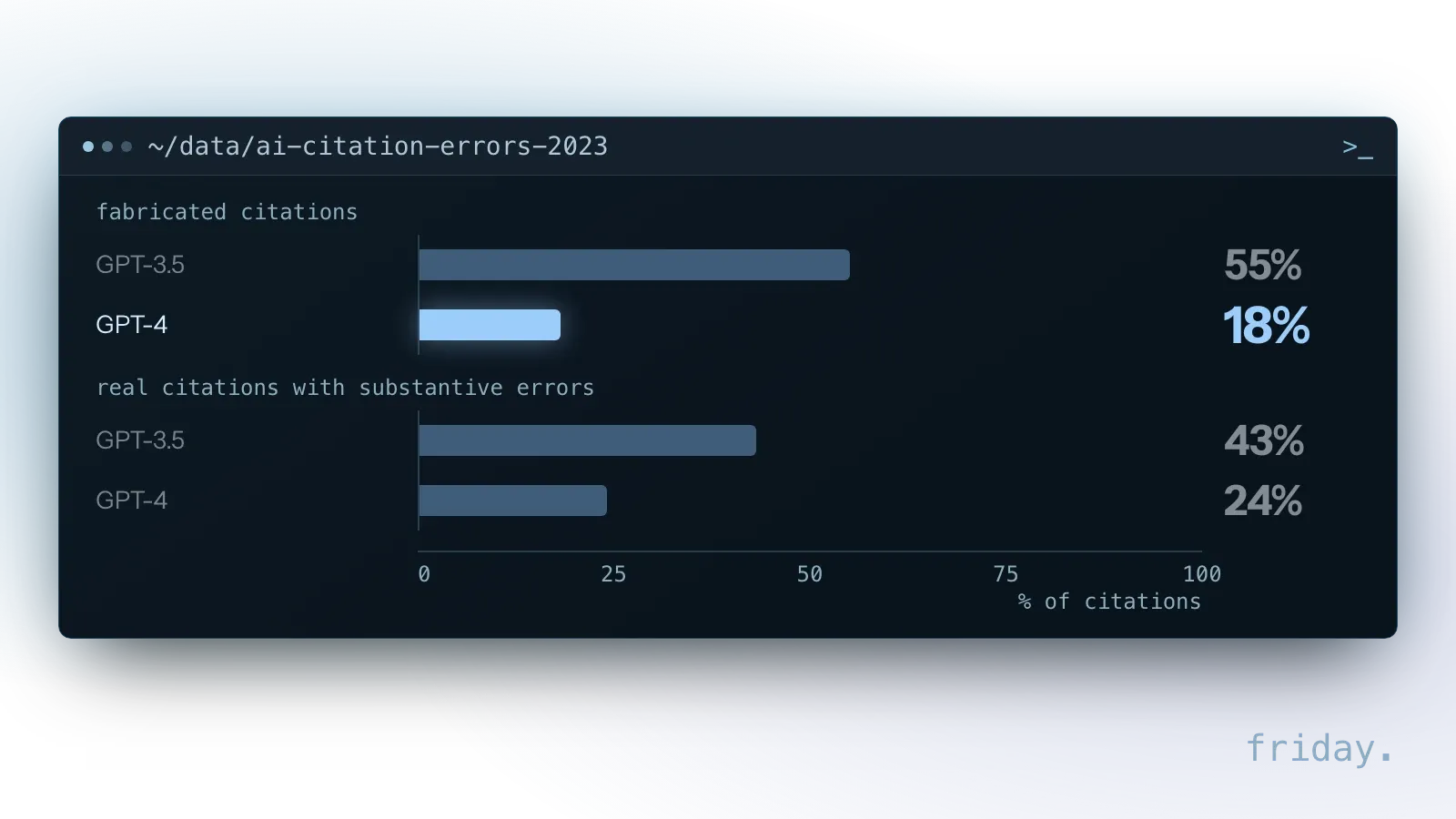
The Walters and Wilder study calls GPT-4 a major improvement over GPT-3.5 and adds that problems remain. The substantive errors it counted in real citations were wrong details such as the authors, title, journal, publisher, volume number or pages. The study tested two 2023 models on academic references, so its rates do not describe the tool your team uses today. What it shows is that a citation can look complete and still point to nothing.
What counts as an original source
The original is the page where the fact was first published by whoever is responsible for it. Summaries, aggregator posts, search snippets and other AI answers are leads, not sources: they point to where the fact might be.
- If the draft cites a source, open it and find the claim on the page.
- For a statistic, follow the chain until you reach the study, survey or dataset, and note who ran it.
- For a vendor's product details, use the vendor's own documentation or pricing page.
Dates and versions
Check the date on the source and on the fact. A correct price from last year, a product version that has been replaced or a rule that has since changed is wrong today, and AI drafts carry that risk by design. When a source shows a "last updated" date, record it with the claim.
Step 3: Check that the source says exactly that
Finding the right page is half the check. The other half is reading the passage itself and comparing it word by word with the draft, because small changes in wording change what a claim promises.
Four kinds of drift
Drift is a claim that started from a real source and changed on the way into the draft. It is harder to spot than an invented fact, because the link works and the topic matches.
| Drift | Source says | Draft says |
|---|---|---|
| Dropped qualifier | "Up to 2x faster in some workloads" | "2x faster" |
| Wrong scope | A finding about large enterprises | Applied to small businesses |
| Merged sources | Two separate figures | One combined statistic |
| Stale fact | Last year's price or version | Presented as current |
Read the sentences around the number
A figure lifted from its paragraph can lose the condition attached to it: the sample, the year, the region or the product tier. Read the full paragraph, and any notes under a table, before accepting the number. If the source says a finding applies to large enterprises, the draft cannot apply it to a five-person office.
Units, rounding and percentages
Check that units, currency and time periods match: monthly against annual, per user against per account, a percentage against percentage points. Keep the source's rounding. A source that reports 18% supports "18%," and a draft that turns it into "about 20%" has drifted.
Step 4: Rank claims by what an error would cost
Not every claim deserves the same effort. Rank the list by what an error would cost, then spend the checking time from the top down, so the claims customers act on get a full check first.
Claims to check in full
Check thoroughly anything a customer will act on, anything about money, health, law or safety, every number and anything that seems surprisingly neat. Google's guidance on AI-generated content says that on topics where information quality is critically important, like health, civic or financial information, its systems place an even greater emphasis on signals of reliability. NIST makes a related point: risks of confabulated content may be especially important to monitor where generative AI feeds consequential decisions.
Claims that need a quick check
Background statements a reader would not act on, such as the year a well-known company was founded, still get checked, but one reliable source is enough. If a background claim does not survive a quick check, cut it. A sentence the piece does not need is cheaper to remove than to verify.
When to bring in someone who knows the field
When a claim is outside your team's expertise, such as a tax rule, a medical statement or a contract term, ask a person who works in that field to read it. Google's self-assessment questions for content ask whether it is written or reviewed by an expert or enthusiast who demonstrably knows the topic well.
Step 5: Keep a record
Note the source, the date you checked it and any limits for each important claim. By Friday's planning estimate, the record adds about a minute per claim on top of the check itself.
What the record holds
The record pays off when someone asks where a number came from, or when the content needs updating. Keep it next to the final version, with one row per claim:
| Field | What to write |
|---|---|
| Claim | The exact wording from the draft |
| Source | The original page, with its address |
| Passage | The sentence that supports the claim, copied |
| Checked | The date you opened the source |
| Limits | For example, "vendor's own figure" or "2023 data" |
| Checked by | The person who compared the two |
How long a check takes
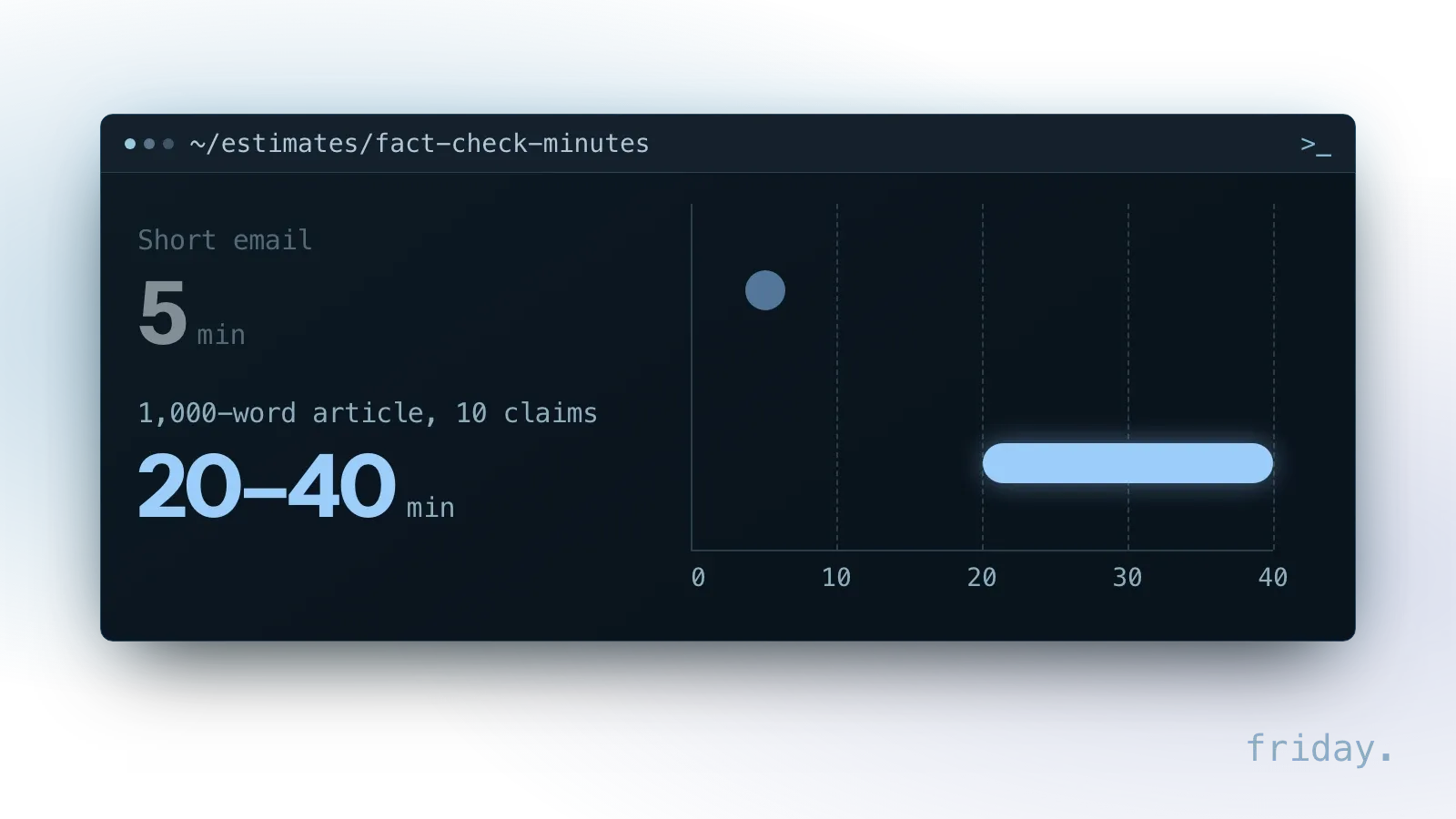
These are planning ranges for budgeting your own time; time a few of your own checks to replace them. A short email takes about five minutes, and a 1,000-word article with ten checkable claims takes 20 to 40 minutes, depending on how hard the sources are to find. Reports with dozens of figures take longer.
Name who stands behind each page
Google's page on creating helpful content suggests thinking in terms of Who, How and Why. It also calls fabricated creator profiles, such as AI-generated headshots, made-up names or false credentials, a form of deception. Put the name of the person who checked each page, and the date of the check, where readers can see it.
Claims that need extra care
Some claims fail in ways a quick read does not catch, and some carry legal weight. These five kinds get a close look in every draft, wherever they fall on the priority list.
Quotes and attributions
Treat every quote in an AI draft as unverified until you find it in the original interview, speech, filing or publication. Models paraphrase and then present the result in quotation marks, or attach a real quote to the wrong person. If you cannot find the exact wording, remove the quotation marks and paraphrase with a link, or cut it.
People, companies and titles
Check names, spellings, job titles and company details against the person's or company's own website or official filings. Roles change, and a draft built on older training data may describe a former executive or a product that has since been renamed.
Links and citations
Click every link. Confirm the page loads, that it is the page the draft describes and that the claim appears on it. A link to a real homepage that does not contain the claim misleads readers as much as an invented one.
Statements about your own business
An AI draft can add features, guarantees or service details that sound right but are not true for your company. Have the person who owns that product or service check every statement about what you offer, what it costs and what customers can expect. These are the claims customers will hold you to.
AI-written reviews and testimonials
Never let an AI draft supply a customer review or testimonial. The FTC's rule on consumer reviews and testimonials, 16 CFR Part 465, in effect since October 21, 2024, makes it unfair or deceptive for a business to write or create a review that materially misrepresents the reviewer or their experience.
The FTC's notice publishing the rule in the Federal Register says AI-generated reviews are covered by the final rule. A testimonial that no customer gave goes out of the copy, and a real one the AI has reworded goes back to the customer for approval or back to their own words. The full text of 16 CFR Part 465 is in the eCFR. This is general information; for your own case, ask counsel.
Make checking a team habit
A routine works only if it survives a busy week. A few house rules, agreed in advance, keep the checks from being the first thing dropped when a deadline gets close.
House rules
- No number without a source. If nobody can find where a figure came from, the sentence is rewritten without it.
- The writer is not the final checker. A second person catches what the writer no longer sees after several rereads.
- Keep the evidence with the draft. Store the brief, the sources and the claim record next to the final version, so every update starts from the evidence.
- Recheck on a schedule. Pages with prices, product details or legal points get a review date as well as a publish date.
A last read against Google's questions
Before publishing, read the piece once against Google's expertise questions for content. One asks whether the content has any easily-verified factual errors. Another asks whether it presents information in a way that makes you want to trust it, such as clear sourcing and evidence of the expertise involved. A draft that has been through the five steps should pass both.
Rechecking published pages
Facts on a published page keep changing after it goes live. Put a recheck date in the claim record, and when it comes, open each source again and compare it with the published sentence. A changed fact becomes an update to the page, logged with the old wording, the new wording and the source.
FAQs About Fact-Checking AI Content
Short answers on using AI to check AI, how long a check takes, what Google says about AI content, claims you cannot source and what Google's fact-check tools can do.
Can I use another AI to fact-check the first one?
It can help list the claims and suggest where to look. The final check is a person comparing each claim with the original source, because a second model can confabulate just as the first one did.
How long should fact-checking take?
By Friday's planning estimate, plan 20 to 40 minutes for a 1,000-word article with ten checkable claims. Reports with more figures take longer.
Is AI content bad for SEO?
Not by itself. Google's guidance says appropriate use of AI or automation is not against its guidelines, while using automation to generate content with the primary purpose of manipulating ranking in search results is a violation of its spam policies.
What should we do when a source cannot be found?
Remove the claim or rewrite the sentence so it no longer depends on it. An unsupported claim is a liability even when it might be true.
Can Google's fact-check tools check my draft?
Google Fact Check Explorer finds fact checks that publishers have already published, so it can help with a claim that circulates widely. It cannot confirm a statement about your business or a statistic nobody has checked. Google says it is phasing out support for ClaimReview markup in Search, while the Factcheck Explorer tool still supports it.
Make checking part of the workflow
If your team publishes AI-assisted content every week, the five steps can be built into the workflow itself, so the checks run on every draft and do not depend on someone remembering them.
Claims can be extracted automatically, sources attached and a reviewer asked to approve before anything is published. See our workflow automation service, or turn your editorial rules into a reusable AI skill.
Tell us what you publish, and we will suggest where the checks belong.
Last checked: November 16, 2026, against NIST AI 600-1, the Walters and Wilder study in Scientific Reports (2023), Google Search Central's guidance on AI-generated content, its helpful-content page and its ClaimReview documentation, and 16 CFR Part 465 with the FTC's Federal Register notice. Guidance and rules change; check the linked pages before relying on a detail.
Sources come from NIST, Scientific Reports, Google Search Central, the eCFR and the Federal Register, checked November 16, 2026.