Dragos Canary Study: Zero Data Retention Requests Leaked
Dragos baited AI services with two million prompts and found three breached hosting providers. Zero Data Retention requests leaked too. What small teams change.
In Friday's view, a business buying AI via a cheap router or reseller should treat each prompt as readable by strangers and keep keys and client data off it.
Dragos seeded two million prompts to see where they went
Dragos, a security company, published a study on November 19, 2026 that followed AI prompts after they left the customer. It used bait secrets that only an outsider would ever touch.
How the canary tokens worked
The study is by HD Moore, Dragos's Chief Research Officer, and appears on the Dragos blog under the title "Three breaches, endless leaks: Your AI supply chain needs canaries." Dragos writes: "Over a five-month period from July through November 2026, we submitted approximately two million prompts containing unique URLs and canary token credentials to widely used AI services and monitored what happened after inference."
Canary tokens are secrets that exist in one place only. In the study's words, "if anyone ever uses it, you know that place has been exposed." Dragos's canary tokens gave each prompt its own AWS key, hostname, URL and credentials; the AWS keys were tied to empty accounts with full logging. When someone used one, Dragos could trace it back to the exact prompt, model, router and privacy setting that carried it.
Where the prompts traveled
Dragos describes AI routers as services that offer "a single API endpoint that forwards your request to a pool of available models," with unified billing. They save money and spare a team from juggling accounts. The catch, in the study's words: "every hop can see the entire prompt and response." Some routers are open marketplaces where the seller with the lowest price gets the request.
Customers can set privacy flags on these services. The strictest is Zero Data Retention, which Dragos explains "specifies that the prompt and response are not stored." Routers are supposed to forward those requests only to providers with the same controls. The study tested whether that holds.
Three hosting providers were breached, Zero Data Retention requests included
Dragos ranks the first finding as its gravest. Bait secrets sent to three AI hosting providers reached attackers, and stolen requests in two of those breaches carried the ZDR flag.
What Dragos saw inside the breaches
"We found attackers actively stealing data from three different hosting providers," the study says. Dragos adds that its prompts were processed along with real customer requests, "and those were almost certainly copied too." The earliest incident dates back to mid-July, and "none of the three providers knew about their breach until we notified them." Dragos does not name the providers.
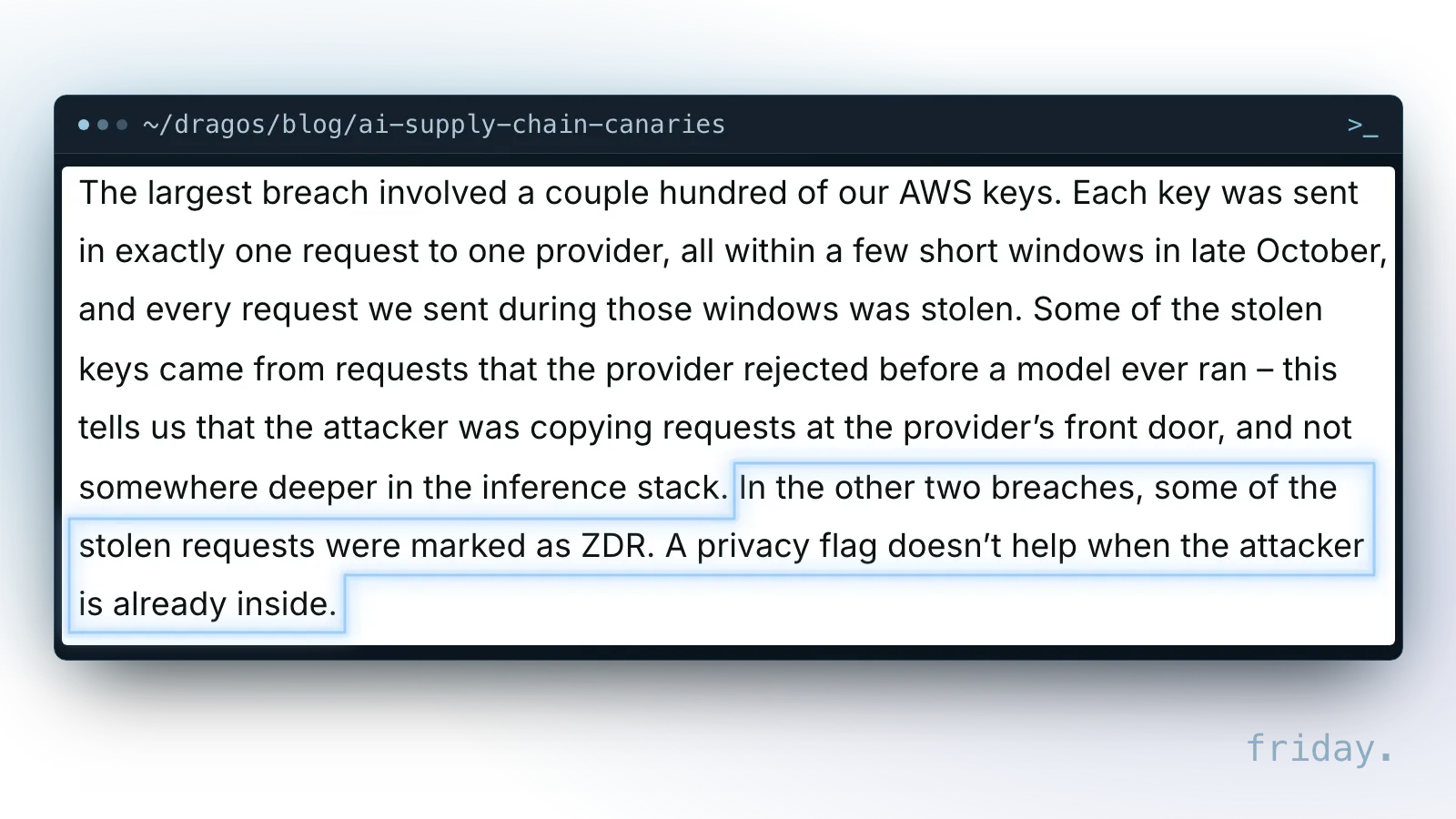
"The largest breach involved a couple hundred of our AWS keys," Dragos writes. Some keys came from requests the provider rejected before a model ever ran, which told Dragos the attacker was copying requests at the provider's front door. "In the other two breaches, some of the stolen requests were marked as ZDR," it adds, and sums it up: "A privacy flag doesn't help when the attacker is already inside."
What the attackers did with the keys
The attackers tested each stolen key, in some cases within a few hours of the request. Then they went looking for data, listing storage buckets and searching AWS's secrets stores, and tried to keep access by creating their own users. "In total, our bait keys were used for tens of thousands of AWS API calls," the study says. In Friday's view, Zero Data Retention would not have changed that outcome, since the attacker was already inside. Had those been real keys to a real business account, the attacker would have been searching that business's files.
Marketplace resellers kept customer prompts without an exploit
The second finding involved no break-in. Sellers on an AI inference marketplace read and kept the prompts that passed through their offers, using the logging the platform already gave them.
The leak followed the seller
Dragos says resellers on the marketplace "were able to view and retain customer prompts using standard logging capabilities, without exploiting a vulnerability or bypassing platform controls." All a seller had to do was list a model at the lowest price, turn on request logging and wait. In one case, two prompts sent through a single seller's offer had their secret web addresses opened about a day and a half later, followed by guessed logins at the bait server. Prompts for the same model sent through a different seller were never touched. Dragos notes that providers “often ignore these settings, either intentionally or due to bugs in their processing flow.”
Hops nobody disclosed
One of the routers Dragos tested was quietly forwarding some of its traffic into the marketplace. Dragos calls it "another example of an undisclosed hop." To see who really handled each request, Dragos built a tracing method and has traced about two thousand routes. Several hundred included a system it could not identify, and a handful sent its test image to a company that was not on the advertised path at all.
In Friday's view, the company on the invoice may not be the only company that reads the prompt, the price picks the path, and a Zero Data Retention setting covers only the first company.
Zero Data Retention flags were ignored further down the chain
The third finding involved no stolen credentials. Companies never meant to see the prompts fetched the secret web addresses inside them, including prompts flagged for no storage.
Requests flagged for no storage were read
Dragos's clearest example is a Chinese AI lab. Its systems "fetched the secret URLs from more than half of the prompts that we sent to its models between July and October, including roughly two-thirds of the requests marked as ‘no data collection’ or Zero Data Retention." Several U.S. hosting providers resell that lab's models, and prompts sent to them triggered the same scraper. Dragos's verdict: "A customer who picked a U.S. provider specifically to keep their data in the U.S. didn't get what they paid for."
In one case, the secret link from a single prompt was posted into a company chat channel 24 days after Dragos sent it. Dragos writes: "Zero Data Retention is supposed to mean something. In practice, these prompts were retained, shared with other companies, and read by people."
Large U.S. providers have issues too
The study does not clear the big names. One large U.S. provider kept crawling a secret URL more than two months after Dragos used it in a single request to its search endpoint. Another runs a scraper that comes back for Dragos's URLs days after each request, whichever router carried it. Dragos does not name these providers either.
What a small business should change in how it buys AI
Dragos closes with five steps. None of them asks a business to stop using AI, and two of them, going directly to a first-tier provider and seeding canaries fit a small team.
Go directly to a first-tier provider
The study's framing: "where your prompts go is a decision, and if you don't make it, the lowest price will make it for you." It also warns that "a privacy flag only binds the first hop," which is why Zero Data Retention set at a router says little about the providers behind it. Its steps, in order: host it yourself if you can afford it; "Go directly to a first-tier provider"; use routers with care; seed your own canaries; and enable secret filtering.
For a small team, self-hosting is a large expense: Dragos lists a Mac Studio with 512 GB of memory from $22,299 and an eight-GPU server from $570,000. Going to a first-tier provider means "One company, one contract, and one privacy policy to read." Dragos is clear that a first-tier provider can still leak "through data sharing agreements or a breach at the provider," but calls it "the smallest exposure you can buy." With one direct contract, a team can read what Zero Data Retention means in that contract. For routers, Dragos says to pick the upstream providers yourself, check that your privacy settings really change where requests go, and stay away from reseller marketplaces.
Seed canary tokens and keep keys out of prompts
Dragos suggests canary tokens for every team: add a fake credential to the context your agents already send and treat any use of it as an incident. It notes that "a free Canarytoken from Thinkst is enough to get started today." Secret filtering, a setting some providers offer to scrub known key formats, "can't hurt, but it's not a panacea." The broader warning applies to every team that uses agents: "AI agents will happily send whatever they can read, including credentials."
In practice, that means no live API keys, passwords or bank logins in prompts, in files an agent reads, or in the instructions a chat tool keeps. If one has already gone through a router, rotate it.
A six-person agency moving off a discount router
For example, a six-person marketing agency pays for model access through a discount router because it bills one account for several models. Staff paste client briefs, ad spend figures and, now and then, a client's API key into prompts to troubleshoot an integration. After reading the Dragos study, the owner moves daily work to a business plan with one first-tier provider and reads that provider's data terms, including what its Zero Data Retention option covers. The owner rotates every key that was ever pasted into a prompt, writes a one-line rule that keys and client logins never go into a chat, and places canary tokens in two shared prompt templates. If one ever fires, the agency knows the path leaked and stops using it the same day.
Friday's view on where prompts go
In Friday's view, the router question belongs on the same list as passwords and payment approvals: the owner decides it once, in writing. For another case where an AI tool became the entry point, see our note on the LiteLLM vulnerability on CISA's exploited list. When an agent needs access to business systems, we set it up with its own scoped keys and written limits as part of our bespoke agent and skills work, so no one pastes a live credential into a prompt.
Before you route another prompt
Dragos found three breached hosting providers, resellers keeping prompts, and Zero Data Retention requests read downstream. It does not name the breached providers, the lab or the large providers.
Before the next invoice, write down which service carries your prompts, whether a router or marketplace sits in between, which keys may have passed through it, and who on the team can paste client data. Rotate those keys, go to a first-tier provider where you can, and place canary tokens in the prompts your agents send. Then check whether Zero Data Retention applies to every hop or only the first. If you want a second pair of eyes on how your team buys model access, send us your current setup.
Last checked: November 22, 2026.
Study details come from Dragos's November 19, 2026 post by HD Moore, the primary source, checked November 22, 2026. Dragos does not name the breached providers, and says it is working with about a dozen providers. Friday has no relationship with Dragos. Statements marked as Friday's view are opinion.