
OpenRouter Drops Three Providers After Dragos Prompt Report
OpenRouter off-boarded three inference providers and removed 125 endpoints from Zero Data Retention eligibility, days after Dragos traced leaked AI prompts.
OpenRouter does not name the three providers it dropped. In Friday's view, a team whose AI tools route through it should find out today whether it was notified.
Why OpenRouter dropped three providers this week
The move follows a study that baited AI services with prompts carrying secrets, then watched who used them. OpenRouter credits that report in its post and says it is adopting the method.
What the Dragos study found
On November 19, 2026, the security company Dragos published a study of where AI prompts go after they leave the customer. We covered it in the Dragos canary study on leaked prompts. The study describes AI routers as services that offer "a single API endpoint that forwards your request to a pool of available models," and warns that "every hop can see the entire prompt and response."
Dragos reported attackers stealing data at hosting providers it did not name, and wrote that some stolen requests "were marked as ZDR," short for Zero Data Retention.
What OpenRouter announced on November 22
OpenRouter's post "Data Processing Incidents on Inference Providers" is dated November 22, 2026. It opens: "Earlier this week, security researchers reported that certain inference providers had data compromised or otherwise shown evidence that their data policies were not being upheld."
It then describes its own role: "As the operating layer between customers and a fast-moving ecosystem of models and providers, we take data policy enforcement very seriously." The post lists three actions already taken and three pieces of work still underway, and it closes with a list of notices from providers on OpenRouter.
What changed for providers on OpenRouter and their endpoints
The three actions are short, and each one touches a different part of the chain: the providers on the platform, the endpoints that carry a ZDR promise, and the customers who sent requests.
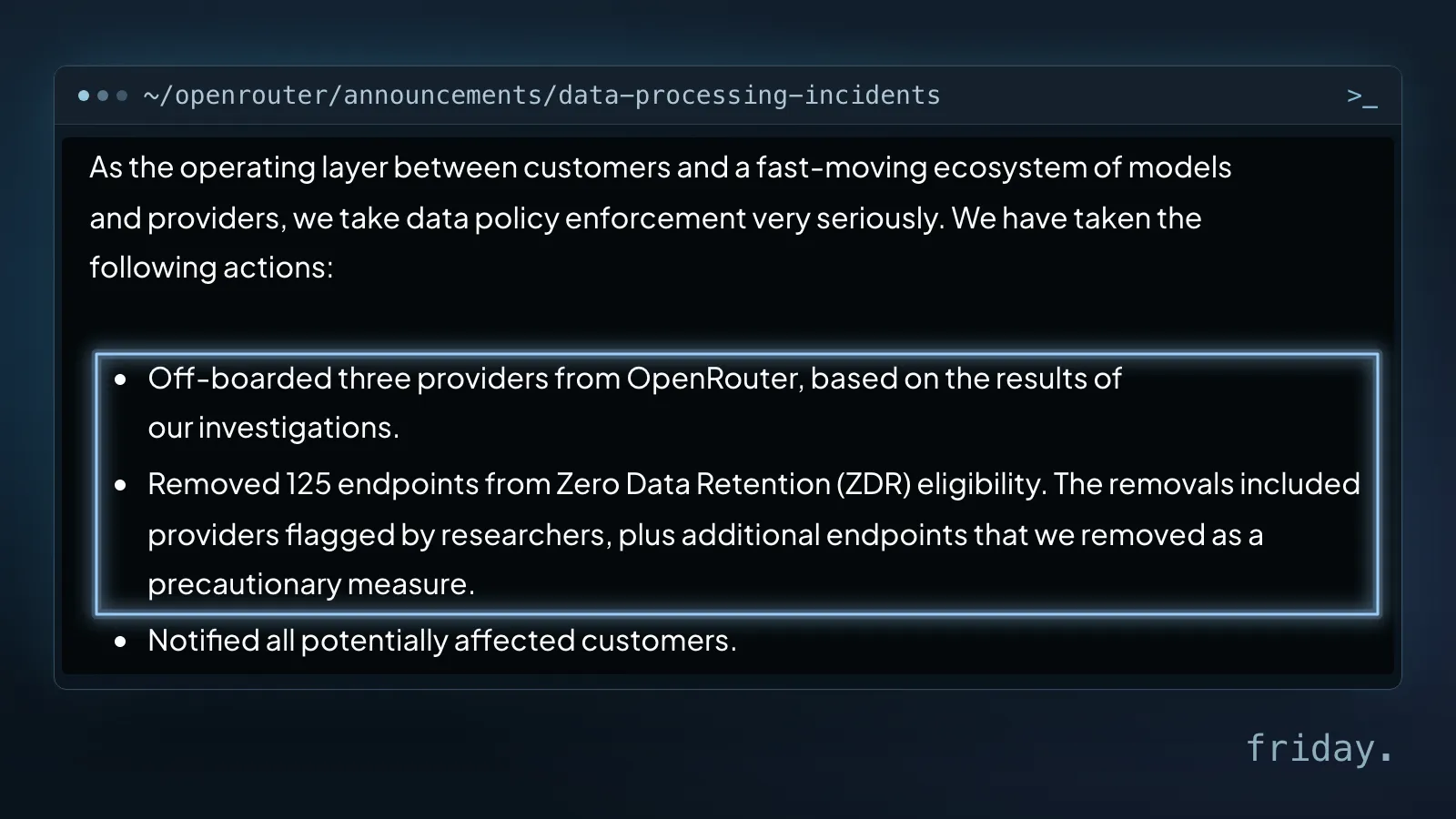
Three providers off-boarded, and not named
The first action reads: "Off-boarded three providers from OpenRouter, based on the results of our investigations." The post's opening sentence covers two kinds of problem: data compromised, and data policies not upheld.
OpenRouter does not say which three providers it dropped. A team trying to work out its exposure cannot tell from this page alone whether the providers that served its requests are among them.
125 endpoints lose ZDR eligibility
The second action reads: "Removed 125 endpoints from Zero Data Retention (ZDR) eligibility. The removals included providers flagged by researchers, plus additional endpoints that we removed as a precautionary measure."
Losing ZDR eligibility does not mean an endpoint leaked: some of the 125 were removed as a precaution. In Friday's view, the practical effect is likely that requests asking for zero retention stop going to those endpoints until their eligibility is restored.
Customers notified
The third action reads: "Notified all potentially affected customers." Near the end of the post, OpenRouter adds: "We have notified affected users regardless of whether there is a public post."
If your team has an OpenRouter account, the notice is the document addressed to your account, and it is the first thing to look for.
What OpenRouter says is still underway
Beyond the three actions, OpenRouter lists three pieces of ongoing work. Together they describe how the platform plans to check providers from now on, and when ZDR eligibility may come back.
Running the researchers' tests on an ongoing basis
OpenRouter writes: "We are adapting the researchers’ testing approach so we can run these checks on an ongoing basis." Dragos's method was to send prompts carrying unique bait secrets and watch whether anyone used them.
The post closes on the same idea: "We are grateful for the Dragos report. As we integrate similar testing techniques into OpenRouter, we will keep raising the bar, and providers that want to be on OpenRouter will need to meet it."
Checking where requests travel
The second piece of work is about hidden hops: "We are conducting technical verification of network paths to identify instances where requests and responses may be being forwarded to third parties."
Dragos described the same risk. A request sent to one provider can be passed on to another company that the customer never chose, and each extra stop is one more place the prompt can be read.
Restoring ZDR eligibility
The third reads: "We are requiring appropriate assurances and validation before restoring ZDR eligibility to any endpoint removed in this review."
The ZDR eligibility of a given endpoint may therefore change again. A model that was available under a zero retention setting last week may not be today, and may return later.
What the provider notices on OpenRouter's page say
Under "Provider security announcements," OpenRouter links to the notices it has received from providers. The list has grown since the post went up, and OpenRouter says it will keep it updated.
Provider notices so far
At the time of our check on November 24, the page linked five provider notices: Atlas Cloud, "Our commitment to your security and privacy"; MiniMax, "Update on URL access in forwarded API requests"; Novita, "Privacy notice regarding MiniMax requests on Novita"; Phala, "November preliminary incident report"; and Together, "Security event: prompt leakage for requests in June and July of 2026."
Each notice is the provider's own statement, and they differ in what they cover. Read the one for any provider your requests went through.
Not every provider has posted
OpenRouter writes: "Not all affected providers have posted publicly." It adds that it is "encouraging all providers to create incident write-ups and will keep this list updated."
The list of notices from providers on OpenRouter is a starting point, and it may grow. A team that finds no notice for the provider it used has not yet learned that the provider was unaffected.
What the page rules out
OpenRouter states: "These findings did not show any breach or unauthorized access of OpenRouter." The page reports problems at specific inference providers, and says the testing "revealed new findings about specific inference providers."
Some of the 125 endpoints were removed as a precaution. The findings concern specific providers, and the page does not describe OpenRouter itself as compromised.
What to check if your tools use providers on OpenRouter
A small team may never sign up for OpenRouter directly. A chatbot, a coding tool or an automation app may send requests through it, which is why the first step is finding out.
Find out which router your tools use
List the AI tools your team uses for client work, and ask each vendor one question: does our traffic go through a router or a reseller, and if so, which one? If you call models yourself, check your code and settings for an OpenRouter key or base URL, since those requests go to OpenRouter, which passes them to a provider.
If you buy from a vendor that uses OpenRouter, the vendor is the customer OpenRouter says it notified if its requests were potentially affected. Ask the vendor whether it received a notice and what it said.
Read the notice and the provider notices together
If you hold the account, look for OpenRouter's notice in the inbox tied to it. Then read the provider notices linked from OpenRouter's page, and check whether any of the providers on OpenRouter that you used is named there.
Write down what each notice says about dates and data, and what it asks customers to do. If a notice tells you to rotate keys, follow it. In Friday's view, any live key that went into a prompt through a router should be rotated anyway, as we wrote after the Dragos study.
Check your ZDR eligibility settings again
If your team relies on a zero retention setting, check which providers on OpenRouter and which endpoints still carry ZDR eligibility today. In Friday's view, a workflow pinned to one model on one provider could now behave differently, so test it.
Keep a record of which provider served each kind of request from now on. That record is what you will need the next time a provider notice arrives.
A five-person bookkeeping firm with a client chatbot
For example, a five-person bookkeeping firm answers client questions through a website chatbot that a small vendor built. This week, the owner asks the vendor whether the chatbot runs through OpenRouter and whether it received a notice.
The vendor confirms it does and forwards the notice. The owner reads the provider notices on OpenRouter's page, checks whether any client tax details went into chat prompts, and asks the vendor to keep a monthly list of the providers on OpenRouter that answer the firm's requests.
Friday's view on routers and retention labels
In Friday's view, a zero retention label is a promise passed down a chain, and it holds only as far as the last company that actually reads the prompt. OpenRouter's move shows a platform acting on outside testing, which is useful; it also shows how little a customer can see on its own.
For agents and workflows that handle client data, we prefer fewer hops and named providers. When we build bespoke AI agents, the provider list is part of the design.
Before you route another client prompt
OpenRouter dropped three providers it does not name, pulled 125 endpoints from ZDR eligibility, and says it notified every customer that may have been affected.
The provider notices it links are a start, and OpenRouter says not every affected provider has posted one. Your own notice, if you hold an account, is the document addressed to you.
Find out which tools send requests to providers on OpenRouter, read the notices, and keep secrets out of prompts. This is general information, not security advice for your setup. If you want help mapping where your team's prompts go, send us the AI tools you use.
Last checked: November 24, 2026.
Details come from OpenRouter's November 22, 2026 post, "Data Processing Incidents on Inference Providers," the primary source, checked November 24, 2026. OpenRouter does not name the three off-boarded providers, and Friday does not either. Friday has no relationship with OpenRouter, Dragos or any provider named here. Statements marked as Friday's view are opinion.